
Short answer
The best way to clean render is a low-pressure soft wash with a render-safe biocide — never a high-pressure jet wash. Apply the biocide, let it kill the algae, lichen and black spotting at the root over the following days and weeks, and the green and grey staining fades without damaging the surface. Our exterior cleaning starts from £125, and the price of a soft-wash render clean depends on the size of the house and access, confirmed from a few photos.
Why Chester render greens over so fast
Rendered walls are everywhere across Chester, Cheshire and the Wirral — from the white-painted semis around Hoole and Saughall to newer estates in Saltney, Blacon and Broughton, and the K-Rend and silicone render on a lot of recent Flintshire and Wrexham builds. They look smart when they are clean, and tired and patchy the moment growth takes hold.
Our climate is the problem. North-West weather sits damp for much of the year, north-facing walls barely dry out, and properties near the Dee, under trees or close to the Wirral coast green over quickly. That green film, the black spotting and the crusty grey lichen are all living growth feeding on a permanently moist surface — which is exactly why a quick blast with a hose or a pressure washer never lasts.
Render is also softer than it looks. Modern thin-coat silicone and acrylic renders, and older painted sand-and-cement, can both be scarred, cracked or stripped by the wrong approach. Get water behind the render and you risk blown patches and damp inside — so the method matters far more than the muscle.
Green algae, black spots and red-brown staining — what you're actually looking at
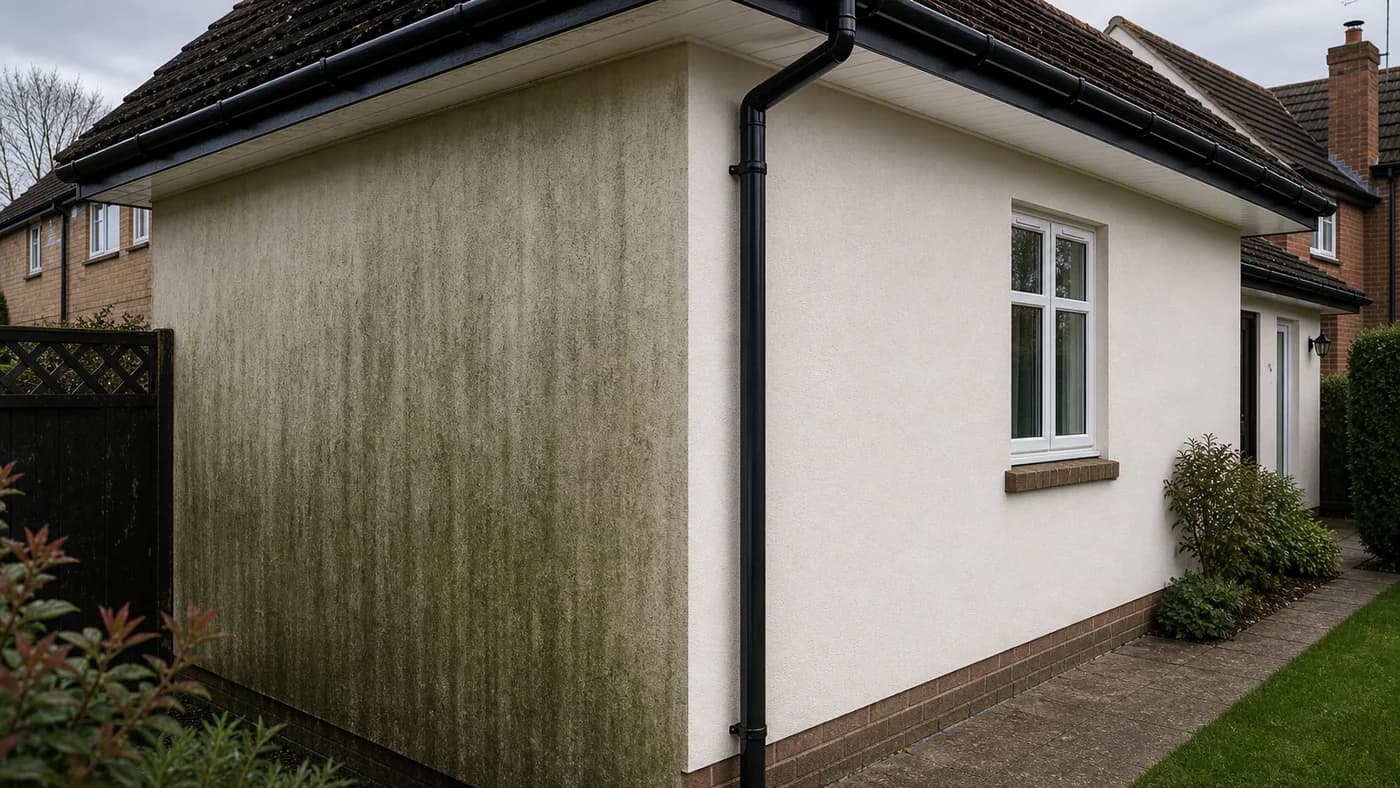
Not all render staining is the same, and knowing what you are looking at helps you treat it properly. The soft green film that spreads across a wall is algae — simple growth that thrives on damp, shaded surfaces and is the most common complaint we see on Chester render. The black speckling and streaks that often go with it are usually a mix of algae and airborne dirt binding to the surface, worst on north-facing and sheltered elevations that never fully dry out.
The red-brown or orange staining that puzzles a lot of homeowners is a different organism again — a rust-coloured alga that can look alarming but responds to the same soft-wash biocide as the green. Crusty grey, white or yellow patches are lichen, a slower-growing partnership of alga and fungus that grips the surface hard and needs the treatment left to do its work rather than being scraped or scrubbed off.
The important point is that every one of these is living growth, not just dirt. That is why the treatment — a biocide that kills it at the root — matters far more than scrubbing or blasting. Remove only the surface layer and the spores left behind simply regrow, usually within a season in our damp climate.
How to clean render safely, step by step
- 1
Check the render and protect what's below
Look for cracks, blown or hollow-sounding patches and loose or flaking paint before any water touches the wall. Cleaning will not fix damaged render, and soaking it can make faults worse. Close windows and doors, and cover plants, paths, furniture and anything below the wall, because biocide run-off can mark surfaces and harm planting.
- 2
Pick a dry, still day
Apply the treatment when no rain is forecast for at least a few hours and ideally a day, so it soaks in rather than washing straight off. Avoid strong sun on the wall and windy conditions, which either dry the product too fast or drift it onto neighbouring surfaces and plants.
- 3
Soft wash, never pressure wash
This is the golden rule. Use a low-pressure sprayer or pump — a gentle flow that wets and rinses, not a jet that blasts. High-pressure lances force water into the surface, blow out the texture and strip thin-coat and painted render. On render, the chemical does the work, not the pressure; a pressure washer is the single most common way render gets ruined.
- 4
Apply a render-safe biocide and let it work
Wet the render evenly with a proper soft-wash biocide, working from the bottom up so it doesn't streak. Then leave it. A biocide is not instant — it keeps killing the algae, lichen and spores for weeks and often months after application, and the growth dies back and weathers off gradually. Resist the urge to jet it clean the next day; that patience is exactly what makes a soft wash last.
- 5
Rinse or brush off gently, only if needed
Once the growth has died back, a gentle low-pressure rinse or a soft brush lifts any loosened residue. Heavy lichen may need a second application rather than force. The wall should be left even, with no gouges, streaks or bright scoured patches where the surface has been over-worked.
- 6
Keep it clean between washes
A light maintenance spray every couple of years, clearing gutters so walls don't stay wet, and cutting back overhanging trees and shrubs all slow regrowth — especially on shaded, north-facing elevations that never really dry out.
Your safe render-cleaning checklist
- Identify the render type first — painted sand-and-cement, K-Rend or silicone thin-coat, or acrylic — because it changes what is safe to use
- Inspect for cracks, blown patches and loose paint, and fix those before cleaning, not after
- Use a low-pressure soft wash and a render-safe biocide — never a pressure washer or jet lance
- Choose a dry, still day with no rain due, so the biocide soaks in instead of washing off
- Protect windows, paths, furniture and planting from run-off before you start
- Apply evenly, then leave the biocide to work over days and weeks — don't rinse it straight back off
- Keep both feet safe — anything above single-storey means working at height, so call a professional rather than climbing a ladder with a lance
- Book a soft wash every two to three years, sooner on shaded, north-facing or tree-lined walls
Professional render cleaning — CPAGM prices in Chester & Cheshire
| Job | Guide price | What affects it |
|---|---|---|
| Render cleaningSoft-wash treatment of a typical rendered elevation — biocide applied and left to work | Confirmed from photos | Soft-wash treatment of a typical rendered elevation — biocide applied and left to work |
| Soffit and fascia cleaningRoofline boards and plastics cleaned, often added to the same visit | From £125 | Roofline boards and plastics cleaned, often added to the same visit |
| Full exterior refreshRender soft wash together with soffits, fascias and gutter exteriors | Confirmed from photos | Render soft wash together with soffits, fascias and gutter exteriors |
Exterior cleaning starts from £125 for typical Chester homes. Every job is confirmed after you send a few photos or we take a quick look, because the render type, the wall area, the height and access, and how established the growth is all change the scope.
What render cleaning costs across the UK — typical guide ranges
| Job | Guide price | What affects it |
|---|---|---|
| Single elevation or small render areaSoft wash of one wall or a compact rendered section, easy access | £150–£300 | Soft wash of one wall or a compact rendered section, easy access |
| Whole-house soft wash (semi or terrace)All rendered elevations on an average home | £250–£500 | All rendered elevations on an average home |
| Larger detached or two-storey renderMore area, more height, and access equipment such as poles or a tower | £400–£800+ | More area, more height, and access equipment such as poles or a tower |
| Heavy lichen or long-neglected renderThick, established growth needs extra product and a second application | Add 20–50% | Thick, established growth needs extra product and a second application |
| DIY biocide and pump sprayer (materials only)Product plus a low-pressure sprayer, single-storey only — your time and the risk on top | £30–£70 | Product plus a low-pressure sprayer, single-storey only — your time and the risk on top |
Typical UK guide ranges to sanity-check a quote, not CPAGM's price. These figures reflect soft washing (not pressure washing), which is the industry-standard method for render. Height, access and render type move the number most.
Never put a pressure washer on render — and don't risk a ladder upstairs
A pressure washer is the single most common way render gets ruined: it strips the surface, blows out the texture and forces water in behind, which leads to blown patches and damp. There is no safe high-pressure setting for render. And cleaning upstairs render means working at height — falls from ladders are one of the most common serious DIY injuries in the UK. If the render is above single-storey, cracked or already blown, or you are not sure which type you have, stop and get it looked at before anyone turns a lance on it.
DIY pressure washing vs professional soft washing
| DIY pressure wash | Professional soft wash | |
|---|---|---|
| Effect on render | Strips texture, gouges the surface and can blow patches off | Gentle on the surface — cleans without damaging it |
| How long it lasts | Green growth returns within a season | Biocide kills growth at the root and keeps working for months, so it stays clean far longer |
| Risk of damp | Forces water behind the render | Low pressure keeps water where it belongs |
| Coloured / thin-coat render | Can scour off the colour and water-repellent finish, leaving lighter patches | Exactly the method K-Rend and silicone render are designed to take |
| Working at height | You on a ladder at the wrong settings — a real fall risk | Done safely with long-reach poles or proper access |
| Typical cost | £40–£70 washer hire, plus your time and the risk of a repair bill | Priced from a few photos, insured, with a lasting finish |
K-Rend, silicone and painted render — the differences that matter
Modern coloured renders like K-Rend and other silicone or acrylic thin-coats are coloured all the way through and have a water-repellent surface, which is part of what keeps them looking good. They are also softer and thinner than traditional render, so they must be soft washed only. A pressure washer can blast off the top layer, damage the water-repellent finish and leave permanent lighter patches where the colour has been scoured — an expensive mistake on a self-coloured wall you cannot simply repaint. A render-safe biocide, left to work, is exactly what these surfaces are built to take.
Painted render — usually older sand-and-cement finished with masonry paint — needs a slightly different eye. A gentle biocide soft wash is fine and is the right way to shift algae, but strong chemicals, stiff scrubbing or any pressure will lift and flake the paint, especially where it is already tired. It is always worth treating a small, less visible area first to check the paint is sound before doing the whole wall.
Monocouche and other through-coloured renders behave much like K-Rend: soft wash yes, pressure wash never. If you are not certain which type of render you have, that uncertainty is itself a good reason to get it looked at before anyone turns a lance on it — the wrong method on the wrong render is the quickest way a clean turns into a repair bill.
When to call a professional
Cleaning render at ground level on a single-storey wall is well within reach for a careful homeowner with the right biocide and a bit of patience. The line to watch is height. The moment the render you want to clean sits above single-storey — the upper elevations of a two-storey Chester semi, a rendered gable, or anything you would need to lean a ladder against — the job stops being a bit of exterior cleaning and becomes working at height, which is one of the most common causes of serious DIY injury in the UK.
Professionals reach upper walls safely with proper access — long-reach soft-wash poles that let the operator stay on the ground, or a tower or scaffold where needed — and apply the right strength of biocide evenly across the whole elevation so it weathers uniformly rather than in patches. It is also worth a call if you are unsure what render you have, if the wall is cracked or blown, or if the lichen is thick and long-established, because all three need judgement rather than just product.
CPAGM covers Chester and roughly a 45-minute radius — across Cheshire and the Wirral and into parts of Wrexham and Flintshire, from Hoole, Handbridge and Upton to Saughall, Frodsham, Northwich, Ellesmere Port and Tarporley. Send a few photos of the wall and we will confirm the render type, the method and a firm price before anything starts.
Frequently asked questions
How do I clean render?
Clean render with a low-pressure soft wash and a render-safe biocide, never a pressure washer. Apply the biocide to the render walls on a dry day, let it kill the algae and lichen at the root over the following days and weeks, then rinse gently or leave it to weather off. High pressure strips and damages render, so soft washing is the only safe way to clean it.
What is the best way to clean render?
The best way to clean render is soft washing — applying a render-safe biocide at low pressure and letting it kill the growth at the root, rather than blasting the surface. It cleans without damaging the render and, because the biocide keeps working for months, it stays clean far longer than a jet wash, which only removes the surface layer and forces water behind the wall.
How do I remove algae from render?
To remove algae from render, spray the wall with a render-safe soft-wash biocide and leave it to work — it kills the algae at the root and the green fades over the following days and weeks. Do not scrub or pressure wash it off, because that only removes the surface film and the algae regrows. One good treatment lasts far longer than repeated blasting.
How do you clean K-Rend?
K-Rend and other silicone thin-coat renders are cleaned with a gentle low-pressure soft wash and a render-safe biocide only. They are coloured through and have a water-repellent surface, so a pressure washer can scour off the colour and the finish and leave permanent lighter patches. A biocide left to work is exactly what these renders are designed to take.
How do you clean painted render?
Painted render is cleaned with a gentle biocide soft wash — never harsh scrubbing or a pressure washer, both of which lift and flake the paint. Treat a small, hidden area first to check the paint is sound, then apply the biocide evenly and let it kill the algae. This shifts the green and black staining without stripping the paintwork.
Can I jet-wash my render to clean it?
No — high pressure is the quickest way to damage render. It strips the surface, blows out the texture and can force water behind the wall, causing damp and blown patches. There is no safe pressure-washer setting for render; it should always be soft washed at low pressure with a biocide instead.
Does a biocide keep working after I apply it?
Yes. A soft-wash biocide does not just clean on the day — it stays active in the surface and keeps killing algae spores and lichen for weeks and often months afterwards. That residual action is why the growth keeps dying back long after treatment, and why a soft wash stays clean far longer than physically removing the surface growth.
Why does the green come straight back after I clean it?
Because the staining is living growth. Hosing or scrubbing only removes what is on the surface, so it regrows. A soft-wash biocide kills it at the root and keeps working for months, which is why a proper clean lasts far longer in our damp Chester climate.
How often does render need cleaning in Chester?
Most rendered walls benefit from a soft wash every two to three years. North-facing, shaded or tree-lined walls, and properties near the Dee or the Wirral coast, green over faster and may need it more often. A light maintenance spray between full cleans slows regrowth.
What does professional render cleaning cost in Chester?
As a guide, our exterior cleaning in Chester starts from £125, and a render soft wash can be combined with soffit, fascia and roofline cleaning in one quote. Every job is confirmed after you send a few photos or we take a quick look, because render type, area, height and access all change the scope.
When should I call a professional rather than doing it myself?
Ground-level, single-storey render is manageable for a careful DIYer, but anything above single-storey means working at height, which is a leading cause of serious DIY injury. If the render is on upper elevations, cracked or blown, or you are unsure of the type, call a professional who can reach it safely with soft-wash poles and apply the right biocide evenly.