Short answer
Pressure washing in Chester typically starts from around £125 for a small surface clean such as a path or compact patio; driveways and larger areas depend on the size of the job and access. As a UK guide, pressure washing works out at roughly £3 to £6 per square metre, and black spot treatment or sealing can be added, priced with your quote. Your exact price depends on the surface, its size and condition, and we confirm it from a few photos before anything is booked.
What you are actually paying for
Pressure washing is priced on the surface, the area and the condition far more than the time. A small concrete path is quick; a large, neglected patio coated in black spotting, or a rendered wall greening over, takes longer and often needs the right treatment, not just water at full power.
Across Chester, Hoole, Handbridge and the wider Cheshire and Wirral area we get a lot of damp, shaded exteriors. The climate stays wet for much of the year, north-facing walls and patios barely catch the sun, and homes near the Dee or under trees green over fast. That green film, and the stubborn black spots on patio slabs, are living growth — which is why a cheap, rushed blast comes back looking tired within a season.
The surface itself decides the method. Block paving, Indian sandstone, porcelain, concrete, brick and painted render all behave differently. High pressure is right for some and ruinous on others, so part of what you pay for is matching the approach — sometimes a low-pressure soft wash rather than a lance — to the material in front of us.
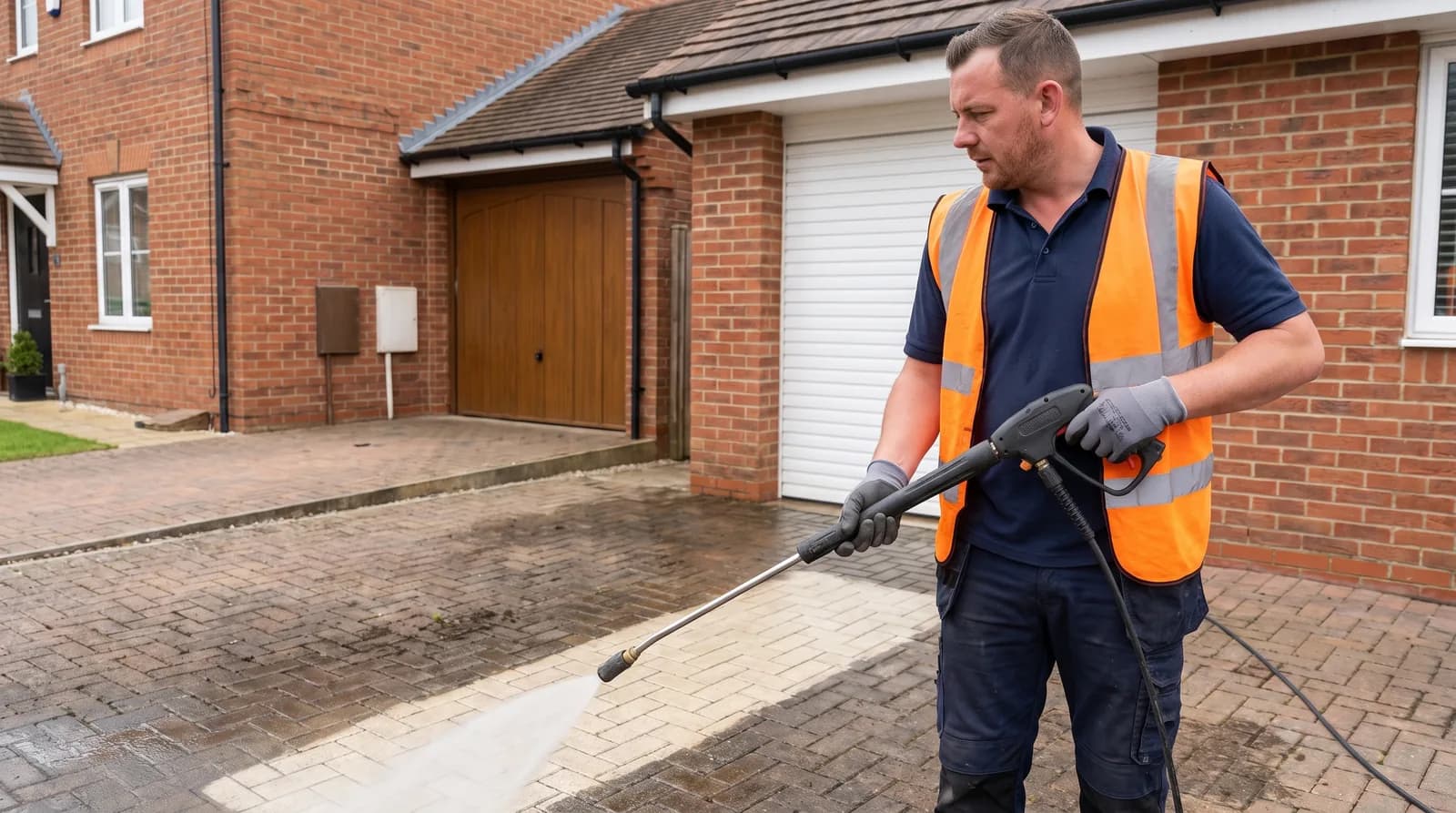
Pressure washing & surface treatments — CPAGM guide prices in Chester & Cheshire
| Job | Guide price | What affects it |
|---|---|---|
| Small surface clean — path, steps or compact patioSingle surface, easy access, light to moderate growth | From £125 | Single surface, easy access, light to moderate growth |
| Standard driveway cleanConcrete or block paving; block paving includes re-sanding the joints | Quoted from photos | Concrete or block paving; block paving includes re-sanding the joints |
| Large driveway cleanMore area, more joints and edging, heavier moss and algae | Quoted from photos | More area, more joints and edging, heavier moss and algae |
| Black spot treatmentTargets the stubborn black lichen spots a plain wash leaves behind | Priced with your quote | Targets the stubborn black lichen spots a plain wash leaves behind |
| Sealing treatment (patio or driveway)Applied after cleaning to protect the surface and slow regrowth | Priced with your quote | Applied after cleaning to protect the surface and slow regrowth |
These are our typical Chester guide prices to plan around. Render, brick and painted walls are usually cleaned by low-pressure soft wash and priced once we have seen photos. Every job is confirmed after a few photos or a quick visit, because the surface type, area, level of staining and any treatment or sealing all change the scope.
Pressure washing cost per square metre — and why we price by the surface
If you search for pressure washing prices in the UK you will mostly see a per-square-metre figure, and it is a fair way to picture the cost. As a broad guide, pressure washing runs at roughly £3 to £6 per square metre for hard surfaces like patios, paths and driveways, drifting to the higher end when the area is small, heavily stained or awkward to reach. A tiny job still carries a minimum charge, because turning up, setting up and packing down takes a slot whether the surface is two square metres or twenty.
That is why we tend to price by the surface and the job rather than by the metre alone. A compact path or set of steps is a small surface clean from £125; a driveway is priced on its size, the block-paving edges and the joints, and we confirm it from a few photos before anything is booked. Black spot treatment and sealing sit on separate lines because not every job needs them — a lightly greened patio may only want a clean, while a lichen-covered one needs the treatment to actually stay clean.
Jet washing and pressure washing are the same job under two names, so a "jet washing cost" and a "pressure washing cost" are quoted the same way here. Whatever you call it, the honest number comes after a couple of photos, because the surface, the area and the state of it move the price far more than the label does.
Typical UK pressure washing prices — market guide
| Job | Guide price | What affects it |
|---|---|---|
| Pressure washing (per square metre)Broad UK rate for patios, paths and driveways; higher for small or stained areas | £3–£6/m² | Broad UK rate for patios, paths and driveways; higher for small or stained areas |
| Small patio, path or steps (up to ~15 m²)Quick single surface with light to moderate growth | £80–£150 | Quick single surface with light to moderate growth |
| Average patio (~20–40 m²)More area and edging; heavier moss and algae push it up | £150–£300 | More area and edging; heavier moss and algae push it up |
| Standard driveway (~30–50 m²)Concrete or block paving; block paving needs re-sanding after | £180–£350 | Concrete or block paving; block paving needs re-sanding after |
| Large or block-paving drivewayBigger area, more joints, re-sanding and often a treatment | £300–£500+ | Bigger area, more joints, re-sanding and often a treatment |
| Timber decking cleanLow to moderate pressure so the soft grain is not damaged | £3–£5/m² | Low to moderate pressure so the soft grain is not damaged |
| Render or wall soft washPriced by height and area; a low-pressure method, not a lance | £150–£400 | Priced by height and area; a low-pressure method, not a lance |
| Sealing treatment (extra)Optional, applied after cleaning to protect and slow regrowth | £3–£8/m² | Optional, applied after cleaning to protect and slow regrowth |
These are typical UK market ranges to plan around, not a CPAGM quote. They are labour-based; black spot treatment and sealing are usually added on top, and sealing is always extra. Your exact price depends on the surface, size, condition and access.
Which surfaces we clean — and why the method changes
Driveways, patios and paths are the everyday jobs. Concrete, natural stone such as Indian sandstone, porcelain and block paving all clean up well, but each wants a slightly different pressure and angle so you lift the grime without scarring the surface or leaving stripes. Block paving is the one to watch: once it is cleaned, the kiln-dried jointing sand between the blocks washes out, so it has to be re-sanded afterwards. Skip that step and the blocks can shift, weeds seed in the open joints and the whole drive loosens — so proper re-sanding is part of doing the job, not an optional extra.
Decking, rendered walls, brick and painted surfaces are where the method matters most. Timber decking cleans up beautifully at low to moderate pressure, but a lance held too close will feather the soft grain and leave it furry. Render, pebbledash, painted masonry and many older walls should not meet a high-pressure lance at all — the safe route is a soft wash, which uses low pressure and the right treatment to kill the green growth and let it rinse away, rather than blasting the coating off the wall.
Across Chester, Hoole, Handbridge, Upton and out towards Saughall, Frodsham, Northwich, Tarporley and Ellesmere Port, damp shaded exteriors are the norm, so the treatment usually matters as much as the wash. We cover Chester and roughly a 45-minute radius across Cheshire, the Wirral and parts of Wrexham and Flintshire.
What a professional pressure wash and treatment involves
- 1
Identify the surface and the staining
We check what the surface is made of and what is actually growing on it — green algae, black spot lichen, oil, or general grime — because each one needs a different treatment, not just more pressure.
- 2
Protect the area and choose the method
We protect borders, drains and pointing, then decide between a pressure wash and a low-pressure soft wash. Soft surfaces and render get the gentler approach so they are cleaned, not scarred.
- 3
Clean, then treat where agreed
We clean evenly at the right pressure for the material, then apply black spot or stain treatment where it is needed so the result lasts rather than greening back over in weeks.
- 4
Re-sand, rinse, seal if agreed, and tidy
On block paving we brush fresh kiln-dried sand back into the joints. We rinse the residue away and, where you have agreed sealing, apply it once the surface is clean and dry to protect it and slow regrowth — then leave the area swept and tidy.
The wrong pressure can do expensive damage
A pressure washer held too close or set too high can strip the surface off paving, blow jointing sand out, force water under slabs, etch brick and shred soft render. On rendered walls, painted surfaces and old or loose paving, the safe answer is often a low-pressure soft wash, not a lance. If you are not sure how your surface will react — or the pointing is already crumbling — get it looked at before anyone turns full pressure on it.
Soft washing vs high-pressure washing
| Soft washing (low pressure) | High-pressure washing | |
|---|---|---|
| Best for | Render, pebbledash, painted walls, timber decking and delicate or old stone | Concrete, block paving, natural stone patios, paths and hard driveways |
| How it works | Low pressure plus a treatment that kills algae and lichen so it rinses off | High-pressure water that physically blasts grime and growth away |
| Risk to the surface | Very low — designed for surfaces high pressure would strip or etch | Can etch, gouge, strip paint or blow out jointing sand if misjudged |
| How long it lasts | Longer — the treatment kills the growth at the root, not just the surface | Good on hard surfaces, but greens back faster without a follow-up treatment |
| Typical use here | Greening render, north-facing walls, decking and soft or older surfaces | Patios, paths and driveways that can safely take the pressure |
DIY pressure washer vs professional clean and treatment
| DIY with a hired washer | Professional clean and treatment | |
|---|---|---|
| Finish | Easy to leave stripes, swirls and patchy areas | Even, consistent finish across the whole surface |
| Surface safety | Real risk of etching, gouging or blowing out jointing sand | Right pressure, or a soft wash, matched to the material |
| Block paving | Sand washes out and rarely gets replaced, so blocks loosen | Joints re-sanded with kiln-dried sand as part of the job |
| Stubborn black spots | Plain water rarely shifts them — they come straight back | Treated at the root so the spotting actually lifts |
| Typical cost | £40–£70 washer hire, plus your day and the risk | From £125, insured, with a finished, treated result |
What makes a pressure washing quote go up or down
A few things move a pressure washing quote. The biggest is area and surface — a large block-paving driveway takes far longer than a compact concrete path, and block paving carries the extra re-sanding step. The second is condition: light green algae rinses off quickly, but established black spot lichen and years of ingrained grime need a treatment and a second pass, not just more pressure.
After that it is what you add and where the job is. Black spot treatment and sealing are optional lines, priced with your quote, that protect the finish and slow regrowth — worth it on some surfaces and unnecessary on others. Access matters too: a back-garden patio reached through the house, or a driveway with nowhere to run the machine and water away, takes longer than an open frontage. Distance plays a small part, as we cover Chester and about a 45-minute radius.
The way to keep it keen is the same as any honest trade will tell you: send clear photos, say what the surface is, and flag anything delicate nearby. We will tell you if a plain wash will do, or if the treatment and sealing are genuinely worth it — rather than adding lines you do not need.
Photos that get you an accurate price fast
- A wide photo of the whole area so the size and surface type are clear
- A close-up of the worst staining — black spots, thick green algae, oil marks or weeds in the joints
- A photo showing access and any delicate surfaces nearby, such as render, painted walls or planting
Frequently asked questions
How much does pressure washing cost?
Most pressure washing jobs in Chester start from around £125 for a small surface clean such as a path or compact patio. Driveways and larger areas depend on the size of the job and access. As a UK guide, pressure washing works out at roughly £3 to £6 per square metre, and black spot treatment or sealing can be added, priced with your quote. We confirm the price once we have seen a few photos, so there are no surprises.
What are typical pressure washing prices in the UK?
Across the UK, pressure washing typically costs about £3 to £6 per square metre for hard surfaces, so a small patio or path often lands around £80 to £150 and an average driveway around £180 to £350. Prices sit higher for heavily stained surfaces, block paving that needs re-sanding, or when sealing is added. These are market guide figures — your exact price depends on the surface, size and condition.
How much does jet washing cost?
Jet washing is another name for pressure washing, so the cost is the same: from around £125 for a small surface clean, with larger areas priced on the size of the job, or roughly £3 to £6 per square metre as a UK guide. Whichever term you use, we quote the job from a couple of photos.
How much does pressure washing cost per square metre?
As a broad UK guide, pressure washing costs about £3 to £6 per square metre for patios, paths and driveways, drifting to the top of that range for small, heavily stained or awkward areas. Sealing is extra, usually adding a few pounds per square metre on top. Because a minimum charge applies, very small jobs work out higher per metre than large open ones.
How much does driveway pressure washing cost?
Pressure washing starts from £125 in the Chester area, and a driveway is priced on its size and condition. Block-paving driveways include re-sanding the joints afterwards, which is essential to keep the blocks stable. Sealing can be added, priced with your quote, if you want to protect the surface and slow regrowth. We confirm the figure from a few photos before anything is booked.
How much does it cost to pressure wash a patio?
A compact patio, path or set of steps starts from £125 as a small surface clean. Larger or heavily black-spotted patios are priced on the area and the treatment involved, and sealing can be added with your quote. As a UK guide that is broadly in line with £3 to £6 per square metre. Send a photo of the whole area and the worst staining for a firm price.
Does block paving need re-sanding after pressure washing?
Yes. Pressure washing block paving flushes out the kiln-dried sand in the joints, and that sand has to be replaced afterwards. Without re-sanding, the blocks can shift, weeds seed in the open joints and the surface loosens over time, so we treat re-sanding as part of the job rather than an add-on.
What is the difference between soft washing and pressure washing?
Pressure washing uses high-pressure water and suits hard surfaces like concrete, block paving and stone patios. Soft washing uses low pressure with a treatment that kills algae and lichen, and is the safe choice for render, painted walls, pebbledash and timber decking that high pressure would strip or damage. We match the method to the surface rather than blasting everything at full power.
Can pressure washing damage my patio, render or decking?
It can, if the pressure is wrong for the surface. Too much pressure can etch paving, strip render and paint, blow the jointing sand out of block paving and furr up timber decking. That is why delicate surfaces get a soft wash instead of a high-pressure lance, and why it is worth getting older or loose surfaces looked at before anyone turns full pressure on them.
Why won't the black spots come off with a normal wash?
Black spots are a lichen that roots into the surface, so plain water just cleans around them. They need a proper black spot treatment to lift them, which is why we price that separately, with your quote.
Is it worth sealing my patio or driveway after cleaning?
Often yes. Sealing a clean, dry surface helps protect it, makes future cleaning easier and slows down moss and algae coming back. We offer sealing once the surface has been cleaned, priced with your quote.
Do you cover Cheshire, Wirral and Wrexham as well as Chester?
Yes. We cover Chester and roughly a 45-minute radius, including the wider Cheshire area, the Wirral and parts of Wrexham and Flintshire — from Hoole and Handbridge to Frodsham, Northwich, Tarporley and Ellesmere Port. Distance can affect a very small job but rarely a full driveway or patio clean.