
Short answer
Should you repair or replace your flat roof? If the leak is in one spot and the rest of the covering is sound, repair it — our roof repairs in Chester start from £95, and the price of a localised flat-roof repair is confirmed from a few photos. If the surface is widely cracked, blistered or holding water and the deck below is soft, a full replacement in EPDM rubber, GRP fibreglass or felt (a typical UK range of roughly £1,000–£3,000+ depending on size and deck condition) usually works out cheaper than repeated patching.
Why so many Chester homes have a tired flat roof
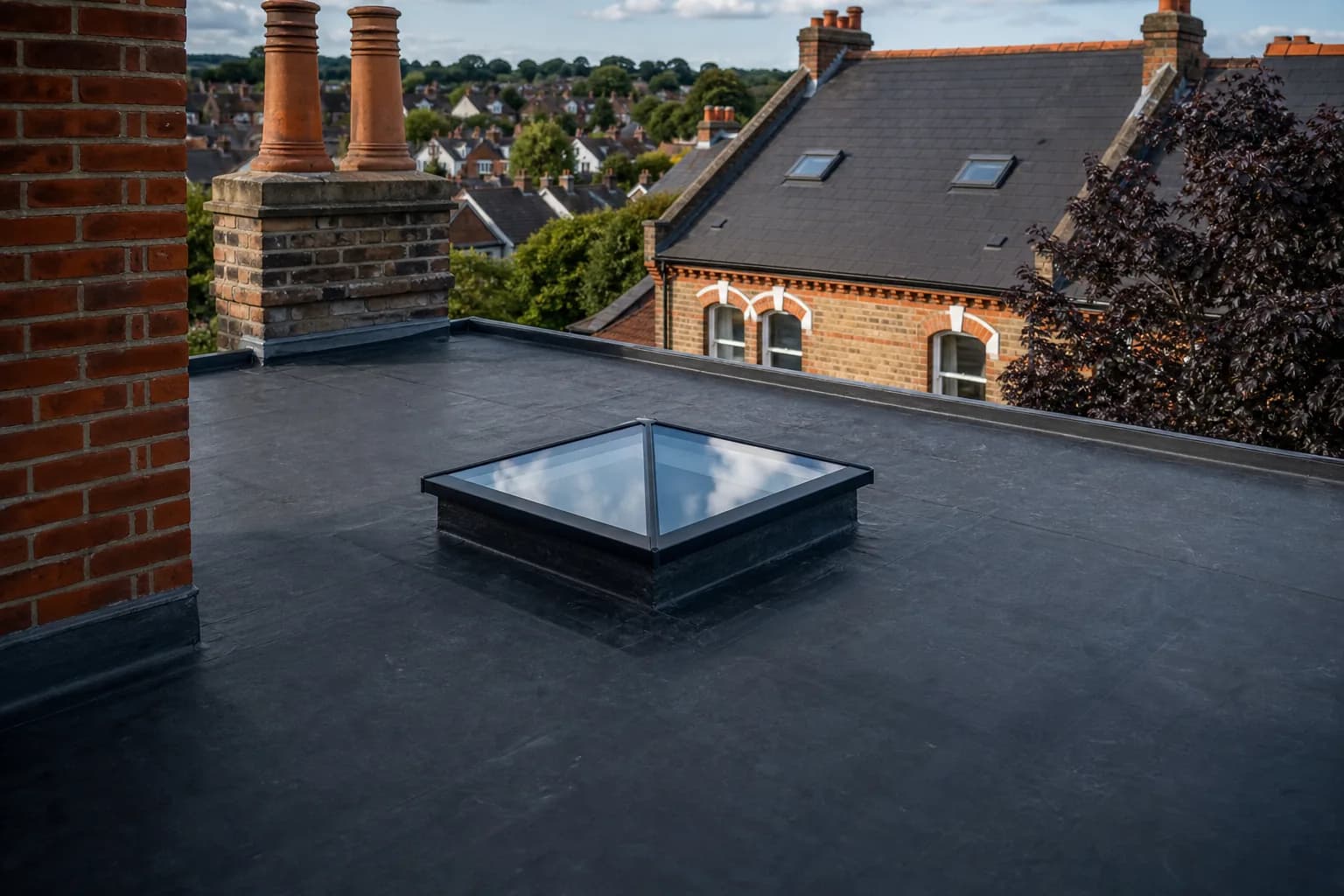
Flat roofs are everywhere across Chester, Cheshire and the Wirral — on the garages and rear extensions of post-war semis, on 1960s-80s estate homes in places like Blacon, Lache and Saughall, on dormers, porches and bay-window tops, and on a lot of the flat-roofed extensions added in the 90s. Most of them are traditional felt, and felt has a working life: a cheap built-up felt roof can be tired in 10-15 years, where a properly laid modern system (fibreglass GRP, EPDM rubber or torch-on felt) lasts a good deal longer.
Our climate is hard on them. Flat roofs sit wet for much of the year, the sun bakes and then frost cracks the surface, and leaves and moss off nearby trees trap moisture and block the outlets. The biggest enemy is standing water — 'ponding' — where the roof has dipped over time and rainwater no longer runs off. Sitting water finds every weak seam and accelerates the felt failing.
The decision between repair and replacement is rarely about the leak you can see. It is about the condition of the whole roof underneath. That is why a quick look in person, or a few clear photos, tells us far more than a price over the phone ever could — and why we would rather give you honest advice than sell you a patch that won't last or a new roof you don't yet need.
Flat-roof repair — our guide prices in Chester & Cheshire
| Job | Guide price | What affects it |
|---|---|---|
| Small roof repairSeal a split, blister or one bad seam on an otherwise sound flat roof | Confirmed from photos | Seal a split, blister or one bad seam on an otherwise sound flat roof |
| Slipped tile repairRe-bed or replace slipped or cracked tiles on an adjoining pitched section or roofline | From £95 | Re-bed or replace slipped or cracked tiles on an adjoining pitched section or roofline |
| Storm damage inspection and reportAfter wind or storm damage — we assess the roof and give you an honest written report | From £95 | After wind or storm damage — we assess the roof and give you an honest written report |
| Re-seal flashing, upstand or outletWhere water is getting in at the edge, the wall join or the rainwater outlet | Confirmed from photos | Where water is getting in at the edge, the wall join or the rainwater outlet |
| Larger flat-roof overhaul or recoverMore extensive felt work where damage has spread but the timber deck is still sound | Quoted on inspection | More extensive felt work where damage has spread but the timber deck is still sound |
| Full flat-roof replacement (new system)Strip back and re-lay in GRP, EPDM or torch-on felt — priced after a visit | Quoted by the m² | Strip back and re-lay in GRP, EPDM or torch-on felt — priced after a visit |
Our roof repairs start from £95 for typical Chester homes. Every job is confirmed after you send a few photos or we take a quick look, because the size, the system, the state of the timber deck underneath and how far the damage has spread all change the scope — and replacement is priced by area, so a fixed figure online would be misleading.
Flat roof replacement cost — typical UK guide ranges
| Job | Guide price | What affects it |
|---|---|---|
| Localised patch or seam repairA single split, blister or failed seam on otherwise sound covering — the low hundreds | £150–£400 | A single split, blister or failed seam on otherwise sound covering — the low hundreds |
| Recover a small flat roof (garage or porch)Over-lay or re-lay a small area where the deck below is still sound | £600–£1,500 | Over-lay or re-lay a small area where the deck below is still sound |
| Full torch-on felt replacementModern high-performance felt — usually the lowest cost for a brand-new roof | £1,000–£2,500 | Modern high-performance felt — usually the lowest cost for a brand-new roof |
| Full EPDM rubber replacementA single-sheet membrane with few seams — long life, popular for garages and extensions | £1,500–£3,000+ | A single-sheet membrane with few seams — long life, popular for garages and extensions |
| Full GRP fibreglass replacementA seamless, hard-wearing finish that copes well with foot traffic on a balcony or dormer | £1,800–£3,500+ | A seamless, hard-wearing finish that copes well with foot traffic on a balcony or dormer |
Typical UK guide ranges for a domestic garage or extension flat roof — NOT a CPAGM quote. Most full replacements land around £1,000–£3,000+ depending on the area in m², the system you choose and how much of the timber deck needs replacing. We price replacement by the metre after a visit.
How long does a flat roof last? Felt, EPDM and GRP compared
The single biggest factor in whether you'll be repairing or replacing is the type of covering and how old it is. Traditional built-up felt — the black, mineral-finish roof on most older Chester garages and extensions — has the shortest life. A cheap two-layer felt roof can be tired and leaking at 10-15 years; a better three-layer or modern torch-on felt, properly laid with the falls right, can push 15-25 years.
The modern alternatives last considerably longer. EPDM rubber is a single large sheet with very few seams to fail, and a well-installed EPDM roof commonly lasts 25-30 years or more — which is why it has become the go-to for garages and extensions across Cheshire and the Wirral. GRP fibreglass gives a seamless, hard-wearing finish that typically lasts 20-30 years and copes well with foot traffic on a balcony or dormer. All three outlive old built-up felt, so if you are replacing, it rarely makes sense to go back to the cheapest felt.
Lifespan is only ever a guide, though. Our wet, frost-prone North West climate, standing water, overhanging trees and how well the roof was laid in the first place all move the real figure up or down. A twenty-year-old EPDM roof with good falls and no ponding can still be sound, while a five-year-old felt roof that holds water can already be failing at the seams. Age tells you when to start watching closely; condition tells you whether to repair or replace.
Old built-up felt vs a modern flat-roof system
| Old built-up felt | Modern system (EPDM / GRP / torch-on) | |
|---|---|---|
| Typical lifespan | 10-20 years, and less where water ponds | 20-30+ years, with EPDM often the longest |
| Weak points | Multiple layers and seams that crack and lift with age | Few or no seams — EPDM is one sheet, GRP is seamless |
| Ponding tolerance | Poor — standing water quickly finds a seam | Better, though good falls still matter on any flat roof |
| Upfront cost | Cheapest to install | Dearer up front, but cheaper over its whole life |
| Best for | A quick like-for-like patch on an otherwise sound older roof | A replacement you won't have to think about for decades |
How we decide repair or replacement
- 1
Find where the water is actually getting in
A damp patch on a ceiling rarely sits directly under the fault — water tracks across the deck before it drips. We trace the real entry point at the felt, the seams, the flashing or the upstand, rather than guessing.
- 2
Check the condition of the whole surface
We look past the one leak. Widespread cracking, lifting seams, blistering and ponding water across the roof point towards replacement; a single defect on otherwise good felt points towards a repair.
- 3
Check the deck underneath
If water has been getting in for a while, the timber or chipboard deck below the felt can be soft or rotten. A sound deck means a repair or recover is realistic; a spongy, sagging deck usually means a proper replacement.
- 4
Give you the honest call and a clear price
You get a straight recommendation with photos — repair it and buy years, or replace it and stop throwing money at patches — plus a price before any work starts.
When to repair vs when to replace your flat roof
| Repair makes sense | Replacement makes sense | |
|---|---|---|
| The leak | One spot — a single split, blister or bad seam | Several leaks, or water getting in across the whole roof |
| The covering's condition | Mostly sound, with one clear defect | Widely cracked, blistered, brittle or lifting at the seams |
| Standing water | Drains away after rain | Persistent ponding that won't run off |
| Age of the roof | Within its expected life, good system | Old built-up felt at or past its working life |
| The deck below | Firm and dry | Soft, sagging or rotten timber |
| How many times it's been patched | First real repair on the roof | Third or fourth patch — new leaks keep appearing |
| Long-term cost | Cheapest fix when the roof has years left | Cheaper than repeated patching once a roof is failing |
Never walk on a flat roof to inspect it yourself
Felt and aged flat roofs are deceptively fragile. A weak or water-damaged deck can give way without warning, and falls from height are the single biggest cause of serious and fatal injury in UK home maintenance. Garage and extension roofs are not designed to be stood on. Leave the inspection to someone working safely with the right access equipment and insurance — checking it yourself is genuinely dangerous and the saving is never worth the risk.
When a flat-roof repair becomes false economy
A repair is the right call far more often than not. If the covering has years left and just one defect, patching it and buying several more years is exactly what we would recommend — there is no sense in replacing a roof that isn't finished. But there is a point where repair stops being sensible, and an honest tradesperson should tell you when you have reached it.
You have usually crossed that line when you are paying for a third or fourth patch on the same roof, when new leaks keep appearing in different spots, when the whole surface is brittle and crazed rather than sound-with-one-fault, or when water has been getting in long enough to soften the timber deck underneath. At that stage each repair is money spent slowing down a roof that is already failing, and it is often cheaper over two or three years to replace it once and stop. Persistent ponding across the whole roof is another red flag — you can seal the seam the water found this winter, but it will simply find the next one.
This is exactly why we inspect first and give you the straight answer, even when that answer is 'this one is beyond a repair'. We would rather tell you a roof needs replacing — and, if it is a large re-roof, point you to the right specialist — than take your money for a patch we know won't hold.
Photos that get you an accurate price fast
- A wide photo of the whole flat roof from above if you can do it safely from an upstairs window — never by climbing onto it
- A close-up of the problem area — the split, blister, lifting seam, or the flashing where the roof meets a wall
- A photo of any inside damage (ceiling stain, damp patch, drips) plus the rough size of the roof and how it's accessed
Frequently asked questions
Should I repair or replace my flat roof?
Repair it if the leak is in one spot and the rest of the covering is sound with a firm deck underneath — a localised repair often buys years. Replace it if the surface is widely cracked, blistered or ponding water and the timber below is soft, because repeated patching then just delays a bigger bill. An honest inspection first is the only reliable way to know which you're looking at.
How much does a flat roof repair cost?
Our roof repairs in Chester start from £95, and sealing a split, blister or failed seam on an otherwise sound flat roof is priced to the job. Across the UK, small patch and seam repairs generally run from the low hundreds. The exact price depends on the size of the fault, the system and how easily the roof can be reached safely — a few photos gets you a firm figure.
How much does a flat roof replacement cost?
Replacement is priced by the area in m², so figures vary, but as a typical UK guide a full flat-roof replacement in EPDM rubber, GRP fibreglass or torch-on felt usually lands around £1,000 to £3,000 or more for a domestic garage or extension. Size, the system you choose and how much of the timber deck needs replacing are the main things that move it. We quote it after a visit rather than guessing online.
How long does a flat roof last?
It depends on the covering. Older built-up felt often starts failing at 10-15 years, especially where water ponds. Modern torch-on felt lasts around 15-25 years, GRP fibreglass around 20-30 years, and EPDM rubber commonly 25-30 years or more. Chester's wet, frosty weather and any standing water shorten every roof's life, so regular checks matter whatever the system.
Which flat roof lasts longest — felt, EPDM or GRP?
EPDM rubber usually lasts longest — commonly 25-30 years or more — because it's a single sheet with very few seams to fail. GRP fibreglass is close behind at around 20-30 years with a tough, seamless finish, and modern torch-on felt around 15-25 years. Old built-up felt is the shortest-lived, which is why we rarely recommend going back to cheap felt when a roof is being replaced.
What is ponding and is it a problem?
Ponding is rainwater that sits on the roof instead of draining away, usually because the surface has dipped over time. It's one of the main reasons flat roofs fail — sitting water finds every weak seam. It's a key sign we look for when deciding repair versus replacement, and persistent ponding across the whole roof often tips the balance towards replacing it.
When is a flat-roof repair false economy?
When you're paying for a third or fourth patch on the same roof, new leaks keep appearing in different places, the whole surface is brittle rather than sound-with-one-fault, or water has softened the deck underneath. At that point each repair only slows a roof that's already failing, and replacing it once is usually cheaper over two or three years than patching it again and again.
Can a flat roof leak be repaired, or does the whole roof need replacing?
If it's one defect on otherwise sound felt with a firm deck underneath, a targeted repair often buys you years. If the surface is widely cracked or holding water and the deck is soft, repeated patches just delay the inevitable — and we'll tell you that honestly rather than keep taking your money.
Do you replace flat roofs as well as repair them?
We focus on repairs and maintenance, and we'll always inspect and give you an honest call first. If a full replacement is genuinely the right answer, we quote it by the metre after a visit, or point you to the right specialist — rather than patching a roof that's beyond it.
Why won't you give me a fixed flat-roof price over the phone?
Because flat-roof work is priced on what's actually there — the size, the system, the state of the deck underneath and how far the damage has spread. A few photos or a short visit means the price you get is real, not a number that changes the moment we're on site.
Do you cover Cheshire, Wirral and Wrexham as well as Chester?
Yes. We cover Chester and roughly a 45-minute radius — the wider Cheshire area including Frodsham, Northwich and Tarporley, the Wirral and Ellesmere Port, and parts of Wrexham and Flintshire. Send a few photos of the roof and we'll give you honest advice and a guide price wherever you are in the patch.