Short answer
Gutters overflow when something stops water reaching the downpipe — usually a blockage of leaves and moss, but sometimes a blocked downpipe, a sagged run with the wrong fall, an undersized gutter, or rain sheeting off a mossy roof. To stop it, clear the whole run, test the flow to the downpipe, then fix the actual cause. A professional ground-based clear starts from around £75. Anything above single-storey height is best left to someone working safely from the ground.
Why is my gutter overflowing? The six common causes
An overflowing gutter almost always comes down to one of six causes, and the fix is completely different for each — so the first job is working out which one you have rather than guessing. Getting this right is the difference between a problem that stays fixed and one that comes straight back next time it rains.
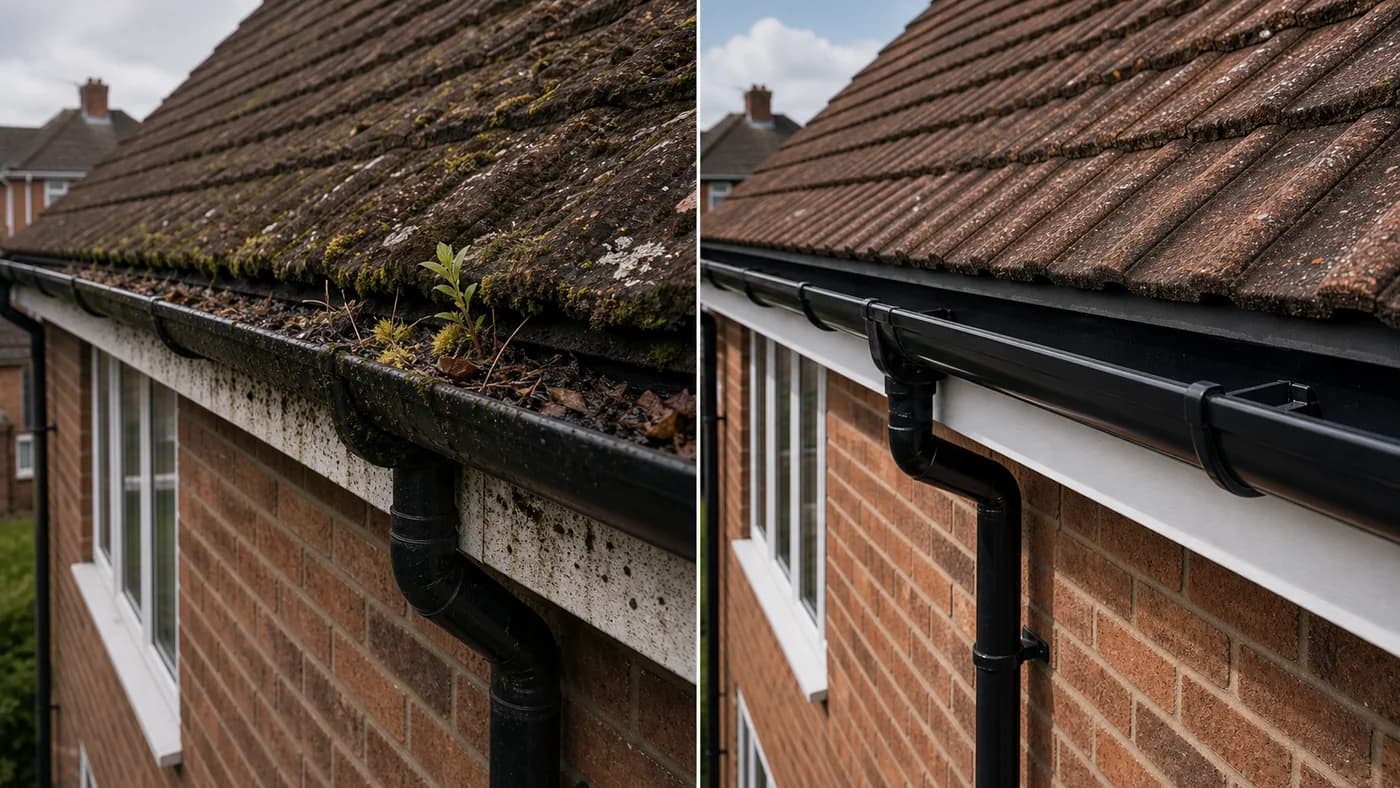
The most common cause by far is a simple blockage — leaves, moss, roof grit and windblown debris turning into a solid sludge that dams the water before it reaches the downpipe. Second is a blocked downpipe or underground gully: the gutter itself looks clear, but water can't drain away, so it backs up and spills. Third is the wrong fall — a run that has sagged because a bracket has loosened, gone missing or been spaced too far apart, leaving water pooling instead of flowing to the outlet.
The fourth cause is a leaking or shifted joint, where a perished rubber seal or a union that has moved lets water drip through a specific spot rather than over the whole front edge. Fifth is an undersized or poorly-positioned gutter that simply can't carry the volume in a real downpour — common on extensions and where a large roof area drains into one short run. And sixth, often mistaken for a blockage, is water sheeting off a steep or heavily-mossed roof so fast in heavy rain that it overshoots the gutter completely and lands on the ground beyond it.

Why Chester gutters overflow so often
Most overflowing gutters in this area are not broken — they are blocked. Across Chester, Hoole, Handbridge and the wider Cheshire and Wirral, we sit wet for a big part of the year, and that damp climate grows moss on roofs and lets leaf debris turn into a solid sludge in the gutter. Once that builds up, water can't reach the downpipe, so it backs up and spills over the front edge.
Tree cover makes it worse. A lot of homes around Hoole, Boughton, Upton and the leafier Wirral roads sit under mature trees, and after autumn leaf-fall the gutters fill fast. Older properties near the city and in the Cheshire villages — think Tarporley, Frodsham or Saughall — often have original cast-iron or early plastic guttering where the joints have shifted, the brackets have loosened, or the run has dropped so water pools instead of flowing away.
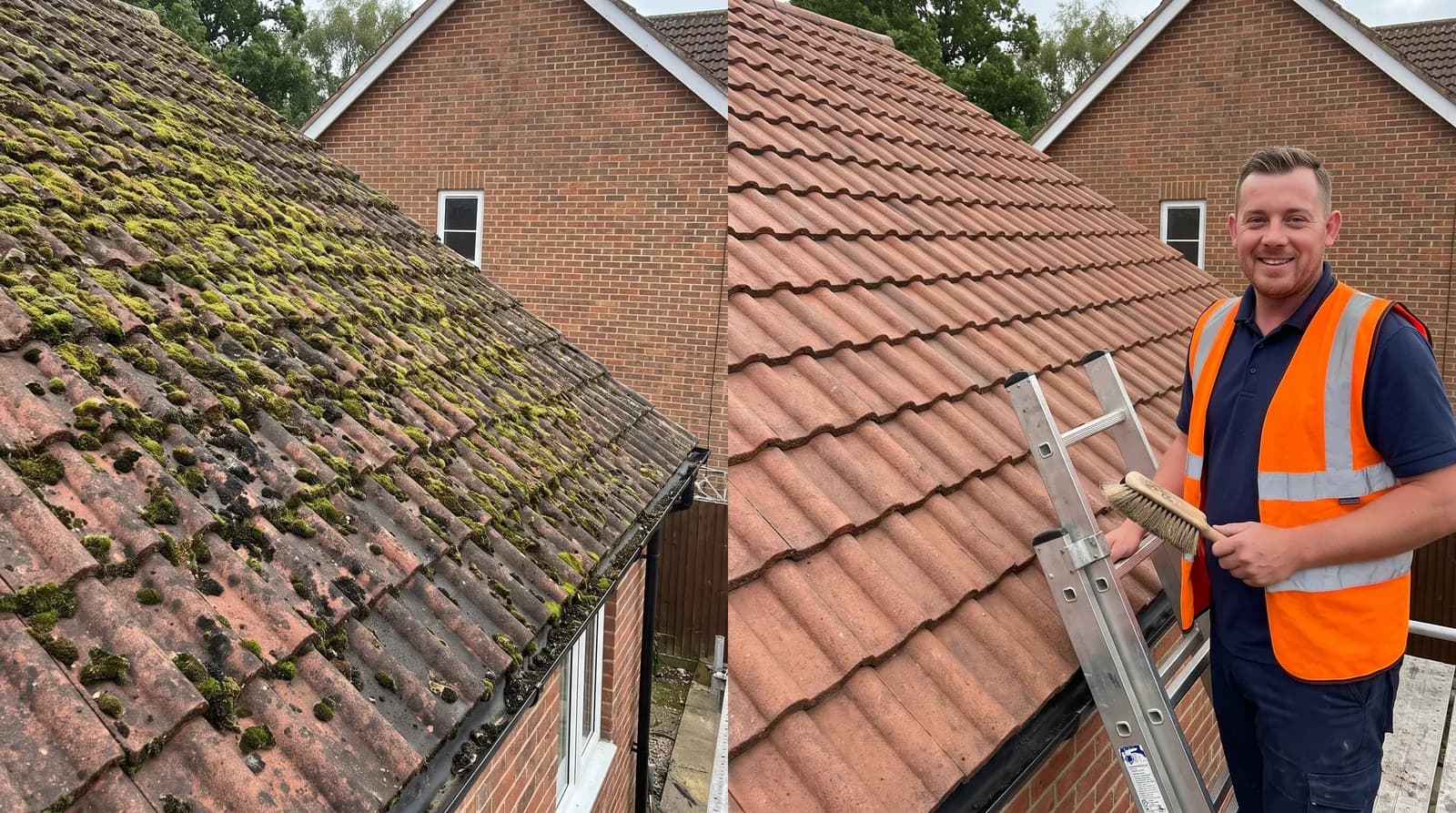
The mossy-roof problem is a Cheshire classic too. North-facing and shaded roofs across the region grow a thick moss layer, and in a downpour the water runs off it in a sheet that can jump clean over the gutter. People assume the gutter is blocked, clear it, and are baffled when it still overflows — because the real issue is up on the roof, not in the gutter.
How to diagnose an overflowing gutter — step by step
- 1
Watch it in the rain to see where it spills
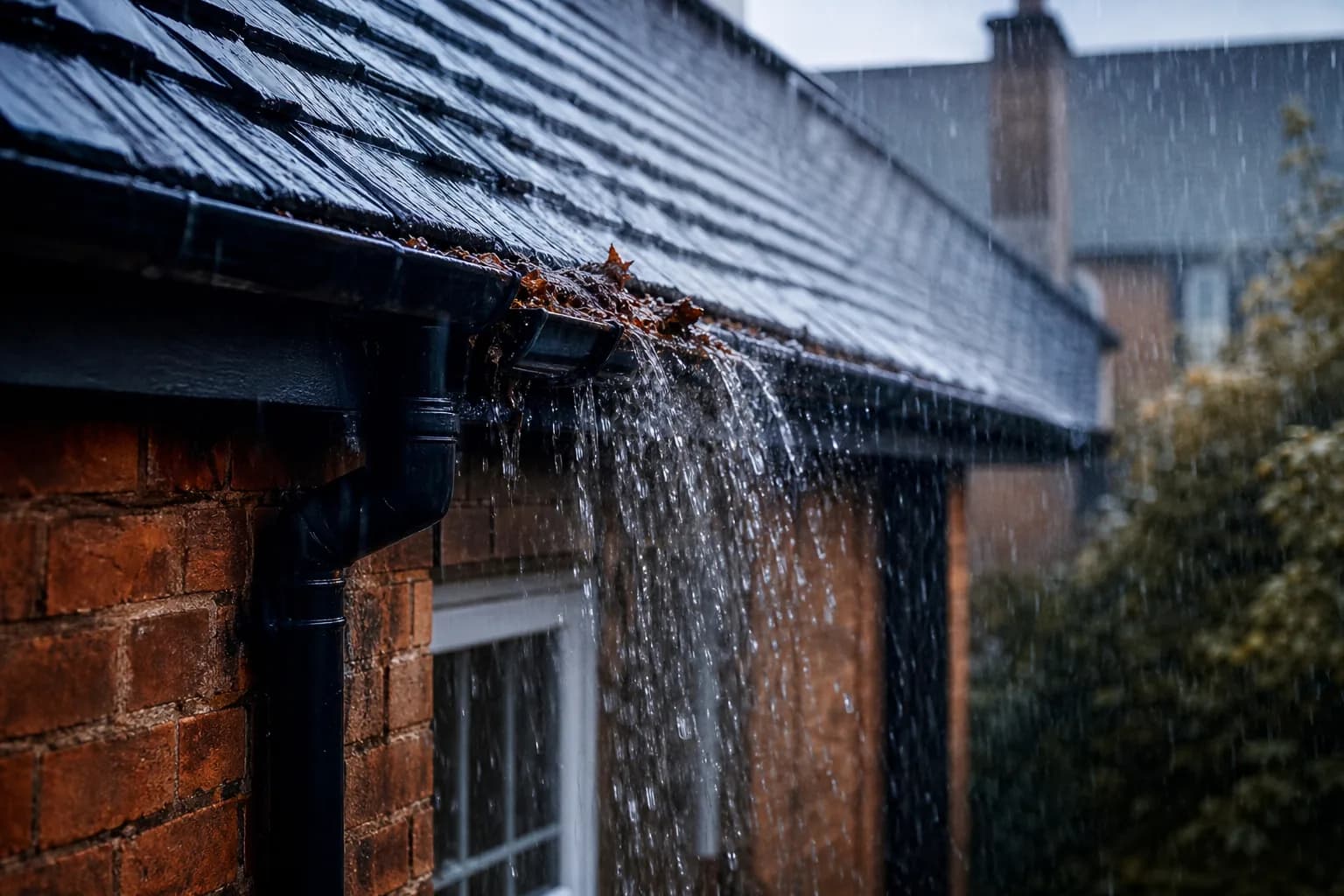
The single most useful thing you can do is stand back during heavy rain (or have someone run a hosepipe into the gutter) and watch. Water spilling evenly over the front edge points to a blockage or a fall problem. Water dripping from one joint between sections is a seal or bracket problem. Water shooting straight over the gutter as it leaves the roof means it's overshooting from a mossy or steep roof, not a gutter fault at all. Pinning down where and how it spills tells you which of the six causes you're chasing.
- 2
Check for the obvious blockage first
Because leaves and moss cause most overflows, rule this out before anything else. From a safe vantage point — an upstairs window, or a safely footed ladder on firm ground for a single-storey run only — look for a dam of dark, wet debris, sprouting weeds or a visible tide line of sludge. Clear the full run, not just the bit you can see, because a blockage 3 metres along will still back water up to where you're standing.
- 3
Test the flow all the way to the downpipe
Once the gutter looks clear, pour a few litres of water in at the far end and watch it actually drain away through the downpipe and out at the bottom. A clear gutter that still overflows is the classic 'not blocked' case: the downpipe itself is blocked — at the top hopper, at a bend, at the shoe at the bottom, or in the underground gully it feeds. This is the step most DIY clears skip, and it's why the gutter overflows again a week later.
- 4
Look for pooling — the fall and bracket check
After clearing, if water sits in standing pools rather than running to the outlet, the run has lost its fall. Guttering needs a gentle, continuous slope towards the downpipe. A sag usually means a loose, missing or wrongly-spaced bracket, or a joint that has dropped. You'll often see the standing water line as a dirty mark inside the gutter. Re-fixing or adding brackets to restore the slope gets the water moving again.
- 5
Inspect the joints for drips
If the overflow is really a drip from one point rather than a spill over the edge, look at the nearest joint or union. The rubber seal has usually perished with age and UV, or the two sections have pulled slightly apart. On modern plastic this is a clean re-seat and re-seal; on old cast iron or brittle plastic it needs the right materials, not a smear of sealant that won't survive one Cheshire winter.
- 6
Rule in the roof and the gutter size
Still overflowing with a clear gutter, clear downpipe and good fall? Two things are left. Look up during rain: if water sheets off a mossy or steep roof and overshoots, the answer is roof moss treatment or a larger/repositioned gutter and a leaf/roof guard — not more clearing. And if a large roof area drains into one short or shallow gutter, it may simply be undersized for the volume, which is a re-sizing job rather than a repair.
Don't go up a ladder for a two-storey gutter
Ladder falls are one of the most frequent causes of serious home-DIY injuries, and a wet, mossy gutter line is exactly when they happen. Single-storey at the back, with firm level ground for a properly footed ladder, is one thing. Reaching out over a two-storey frontage, a conservatory or a flowerbed is not worth it — leave anything above single-storey to someone working from the ground with the right equipment. Most professional clears are now done with a high-reach vacuum from the ground, with no ladder against the house at all.
Safe ground-level checks you can do yourself
- Watch the roofline during heavy rain and note exactly where the water spills — front edge, a single joint, or straight over the top
- Look up from the ground or an upstairs window for a visible dam of leaves, moss or sprouting weeds along the gutter
- Check the ground under the overflow for a splash-back stain or eroded soil — it shows how long it has been happening
- Feel the fascia and soffit at the overflow point from a window for softness or peeling paint (a sign of rot starting)
- Look at the bottom of the downpipe and the gully in rain — if it's dry while the gutter overflows, the downpipe is blocked
- Note any moss sheeting off the roof itself — that's a roof job, not a gutter one
- Leave anything that needs a ladder above single-storey height, or over a conservatory or flowerbed, to a pro working from the ground
CPAGM gutter clearing & repair prices — Chester & Cheshire
| Job | Guide price | What affects it |
|---|---|---|
| Small terrace — gutter clearFull run cleared and cleared debris removed, with before-and-after photos | From £75 | Full run cleared and cleared debris removed, with before-and-after photos |
| Semi-detached — clear with downpipe checkGutters cleared plus the flow tested through the downpipe to catch hidden blockages | Confirmed from photos | Gutters cleared plus the flow tested through the downpipe to catch hidden blockages |
| Detached propertyLarger roofline and multiple runs and downpipes cleared and flow-checked | Confirmed from photos | Larger roofline and multiple runs and downpipes cleared and flow-checked |
| Minor gutter repair visitRe-seal a leaking joint, re-fix or add a bracket to restore the fall, refit a slipped section | From £75 | Re-seal a leaking joint, re-fix or add a bracket to restore the fall, refit a slipped section |
Gutter clearing and repairs start from £75 for typical Chester-area homes, fully insured and cleared from the ground where possible. The exact price is confirmed after you send a few photos and the property details, because the roofline size, access and the cause of the overflow change the scope. We cover Chester and roughly a 45-minute radius across Cheshire, the Wirral and parts of Wrexham and Flintshire.
Typical UK guide prices for related gutter work
| Job | Guide price | What affects it |
|---|---|---|
| Unblock a blocked downpipeClearing a downpipe, hopper or the shoe at the base; underground gullies can cost more | £45–£90 | Clearing a downpipe, hopper or the shoe at the base; underground gullies can cost more |
| Re-seal or replace a leaking jointPer joint; old cast-iron and brittle plastic sit at the top of the range | £45–£95 | Per joint; old cast-iron and brittle plastic sit at the top of the range |
| Re-fix or add gutter brackets to correct the fallDepends on the run length and how much has sagged | £60–£150 | Depends on the run length and how much has sagged |
| Fit gutter guard / leaf guardReduces leaf ingress but still needs occasional checking — see the caveat below | £8–£15 per metre | Reduces leaf ingress but still needs occasional checking — see the caveat below |
| Replace a section of gutteringPer run; more for two-storey access or matching old profiles | £120–£300 | Per run; more for two-storey access or matching old profiles |
Typical UK guide ranges for context only, labour and materials combined — not CPAGM's exact quote. Your firm price comes back after you send a few photos and the details.
Why an overflowing gutter causes damp and fascia rot
An overflowing gutter is never just a nuisance in the rain — the reason to fix it quickly is that the water always ends up somewhere it shouldn't. Water spilling over the front edge runs down the render and brickwork, and in a driving Cheshire wind it's pushed straight back onto the wall, where it soaks in and shows up as a damp patch inside, usually in an upstairs bedroom or on a chimney breast.
Water backing up behind the gutter is worse, because it sits against the fascia board and the soffit — the timber behind and beneath the gutter. Kept wet, that timber softens, the paint blisters, and it eventually rots, which lets water into the roof edge and gives moss, wet-rot and even nesting birds a way in. Replacing rotten fascia and soffit is a far bigger and more expensive job than the clear or minor repair that would have prevented it.
This is why 'clear it and check it' beats 'clear it and hope'. Stopping the overflow at the cause — while it's still a From £75 clear or a From £75 repair visit — is a fraction of the cost of the damp treatment, redecoration and roofline replacement that follows if it's left to run for a couple of winters.
DIY ladder fix vs professional ground-based clean and repair
| DIY with a ladder | Professional ground-based service | |
|---|---|---|
| Safety | Working at height on a wet, slippery roofline — real fall risk | Cleared from the ground with a high-reach vacuum, no ladder against the house |
| Finding the real cause | Easy to clear one spot and miss the sag, fall or blocked downpipe | Whole run checked, flow tested to the downpipe, cause diagnosed |
| Repairs | Hard to re-seal joints or re-fix brackets safely from a ladder | Minor repairs — re-seal joints, re-fix or add brackets — often done same visit |
| Lasting result | Often overflows again within a season if the cause isn't fixed | Cleared and corrected so water actually drains away and stays that way |
| Typical cost | £20–£50 on tools and sealant, plus a day of your time and the fall risk | From £75, fully insured, with before-and-after photos |
How to prevent gutters overflowing again
Once the cause is fixed, keeping it fixed is mostly about regular clearing before the debris has a chance to dam up. For most Chester homes that means a clear once or twice a year — typically in late autumn after the leaves have dropped, and again in spring if the property sits under trees. Homes around Hoole, Upton, Boughton and the leafier Wirral and Cheshire roads usually need two clears a year to stay ahead of it; a house with no overhanging trees might manage on one.
Fixing the underlying condition matters as much as the frequency. A gutter with the correct fall, sound brackets and clean joints copes with far more rain before it overflows, so a one-off repair often reduces how often you need to clear it. If the roof is heavily mossed and shedding grit and moss into the gutter, treating or gently clearing the roof reduces what ends up in the gutter in the first place.
Gutter guards help — but they're not fit-and-forget
Mesh and brush gutter guards genuinely reduce how much leaf debris gets in, which is worth it under trees. But they don't stop fine roof grit, moss and windblown seeds, and a guard that clogs on top can actually make water sheet straight over the edge — so guards still need checking and occasional clearing, not fitting and forgetting. On a heavily-treed or mossy property they're a useful aid alongside a yearly check, not a replacement for one.
Frequently asked questions
Why is my gutter overflowing?
A gutter overflows when something stops water reaching the downpipe. The most common cause is a blockage of leaves and moss, but it can also be a blocked downpipe, a sagged run with the wrong fall, a perished joint, an undersized gutter, or rain sheeting off a mossy roof and overshooting the gutter. The fix depends on which one it is, so it's worth diagnosing before you act.
How do I stop my gutters overflowing?
Clear the whole run of leaves, moss and sludge, then pour water in and check it drains all the way through the downpipe. If it still overflows, look for standing pools (a fall or bracket problem), a dripping joint (a seal problem) or water overshooting from a mossy roof. Fix the actual cause rather than just clearing the surface, and it will stay fixed. Above single-storey height, use a professional working from the ground — a clear starts from around £75.
Why is my gutter overflowing in heavy rain but fine otherwise?
A partial blockage or a slightly wrong fall can cope with light rain but can't move the volume in a downpour, so it backs up and spills. It can also mean the gutter is undersized for the roof area, or that water is sheeting off a mossy roof and overshooting the gutter in heavy rain. Overflowing only in heavy rain is an early warning to clear the run and check the fall before it gets worse.
My gutter is overflowing but it's not blocked — what's wrong?
If the gutter itself is clear, the problem is usually downstream or structural: a blocked downpipe or underground gully, a section that has sagged so water pools instead of flowing, an undersized gutter, or water overshooting from a steep, mossy roof. The flow test — pouring water in and watching whether it drains through the downpipe — tells you which it is. A clear gutter that still overflows almost always means the downpipe is blocked.
What are the most common causes of an overflowing gutter?
The six common causes are: a blockage of leaves and moss (most common); a blocked downpipe or gully; the wrong fall from sagging or loose brackets; a leaking or shifted joint; an undersized gutter that can't carry the volume; and rain sheeting off a mossy or steep roof so fast it overshoots the gutter. Each has a different fix, which is why diagnosing the cause first saves fixing the wrong thing.
How do you fix an overflowing gutter?
You fix it by matching the repair to the cause: clear a blocked gutter and downpipe; re-fix or add brackets to restore the fall on a sagged run; re-seal or re-seat a leaking joint; treat the roof or fit a guard if moss is overshooting; and re-size the gutter if it genuinely can't carry the volume. Clearing is only half the job — the flow to the downpipe should always be tested afterwards so it actually stops overflowing.
Can overflowing gutters cause damp inside the house?
Yes — that's the main reason to fix it promptly. Water spilling over the edge runs down the render and brickwork and soaks into the wall, showing up as damp patches inside. Water backing up behind the gutter sits against the fascia and soffit and eventually rots the timber. Stopping the overflow early, while it's still a small clear or repair, is far cheaper than treating the damp and replacing rotten roofline later.
How often should I clear my gutters in Chester to stop this?
Once or twice a year for most homes, typically after autumn leaf-fall. Properties under trees around Hoole, Upton, Boughton or the leafier Wirral and Cheshire roads usually need two clears a year to stay ahead of it, while a house with no overhanging trees might manage on one. Fixing the fall and joints as well means the gutter copes with more before it overflows, so it needs clearing less often.
Do gutter guards stop gutters overflowing?
They help but don't guarantee it. Mesh and brush guards reduce how much leaf debris gets in, which is useful under trees, but they don't stop fine roof grit, moss and seeds, and a guard that clogs on top can make water sheet over the edge. Guards are a useful aid alongside an annual check, not a fit-and-forget fix — they still need occasional clearing.
How much does it cost to fix an overflowing gutter in Chester?
A gutter clear starts from £75 for a small terrace, and a minor gutter repair visit — re-sealing a joint or re-fixing brackets to correct the fall — is also from £75. The exact price is confirmed after you send a few photos and the property details, because the roofline size, access and the cause change the scope.
Will you fix the cause, not just clear it?
Yes. Clearing is only half the job — we test the flow to the downpipe, check the fall and brackets, and re-seal leaking joints so the gutter actually stops overflowing rather than blocking up again next season. If the real cause is up on the roof or an undersized gutter, we'll tell you that too rather than just clearing it and leaving you with the same problem.