
Short answer
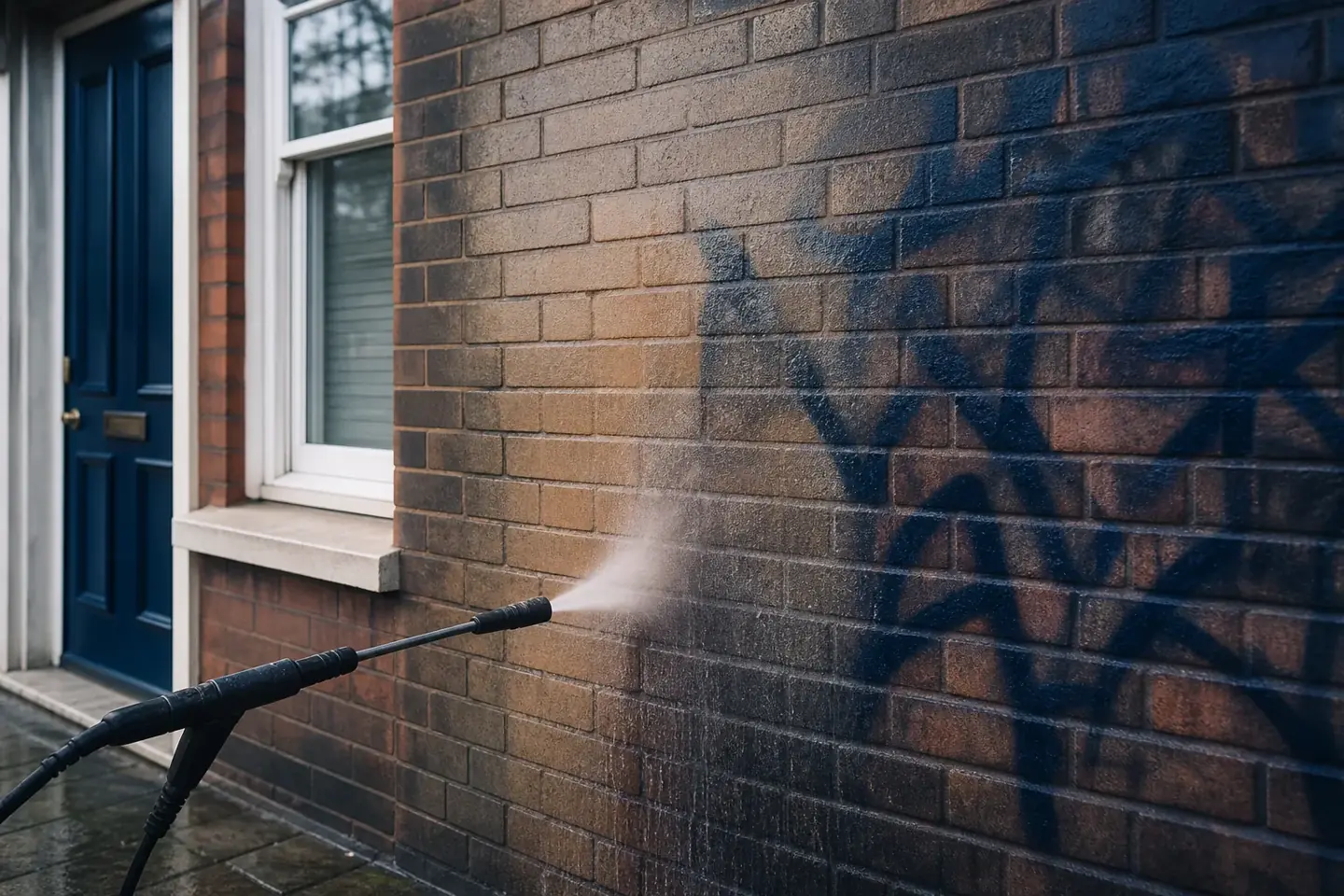
Graffiti removal in Chester starts from £125 for a small tag on an accessible surface, and we confirm your exact price from a few photos before anything is booked. What you pay depends on the surface, the size of the area, the type of paint used, and how long it has been left on — fresh paint is far cheaper to shift than paint soaked into bare brick or stone.
Why surface and speed matter most
Graffiti removal is priced on the surface and the condition far more than on the size of the tag. A few sprayed letters on smooth painted render lift cleanly, while the same letters soaked into bare brick, sandstone or rough render take far more work because the paint has gone into the pores of the surface.
Across Chester, Hoole, Handbridge and the wider Cheshire and Wirral area, a lot of property is exactly the surface graffiti is hardest to shift — soft red sandstone, old brick, painted boundary walls, and the kind of porous render that soaks paint straight in. Chester's listed and historic walls in particular need a careful approach, because aggressive cleaning can mark the stone worse than the graffiti did.
Time is the other big factor. Fresh paint nearly always comes off more easily and more cheaply than paint that has been baked on by sun and weather for months. The longer it stays, the deeper it sets and the more likely you are to need a stronger method — so getting it dealt with quickly usually keeps the cost down.
Graffiti removal — guide prices in Chester & Cheshire
| Job | Guide price | What affects it |
|---|---|---|
| Small tag — accessible surfaceA single tag or small area on smooth, easy-to-reach paintwork or render | From £125 | A single tag or small area on smooth, easy-to-reach paintwork or render |
| Boundary wallBrick or rendered wall, larger area, ground-level access | Confirmed from photos | Brick or rendered wall, larger area, ground-level access |
| Commercial frontage or shutterShopfront, larger run, or where the surface needs extra care | Confirmed from photos | Shopfront, larger run, or where the surface needs extra care |
| Porous surface (bare brick / sandstone)Soaked-in paint on absorbent stone or brick takes longer and may need specialist treatment | Confirmed from photos | Soaked-in paint on absorbent stone or brick takes longer and may need specialist treatment |
| Anti-graffiti protective coatingOptional add-on so the next tag wipes off far more easily | Priced with your quote | Optional add-on so the next tag wipes off far more easily |
Graffiti removal starts from £125 for typical Chester properties. The job is confirmed after a few photos or a quick visit, because the surface type, area, paint used and how long it has been there all change the scope.
Why the right method matters more than raw power
It is tempting to think the answer to graffiti is simply to blast it off with a high-pressure jet or a sandblaster. On the wrong surface that causes more damage than the paint ever did. High-pressure water and abrasive blasting can open up the face of soft red sandstone, strip the weathered skin off old brick, and gouge lines into lime or sand-cement render — leaving a rough, patchy area that then soaks up dirt and the next tag even faster.
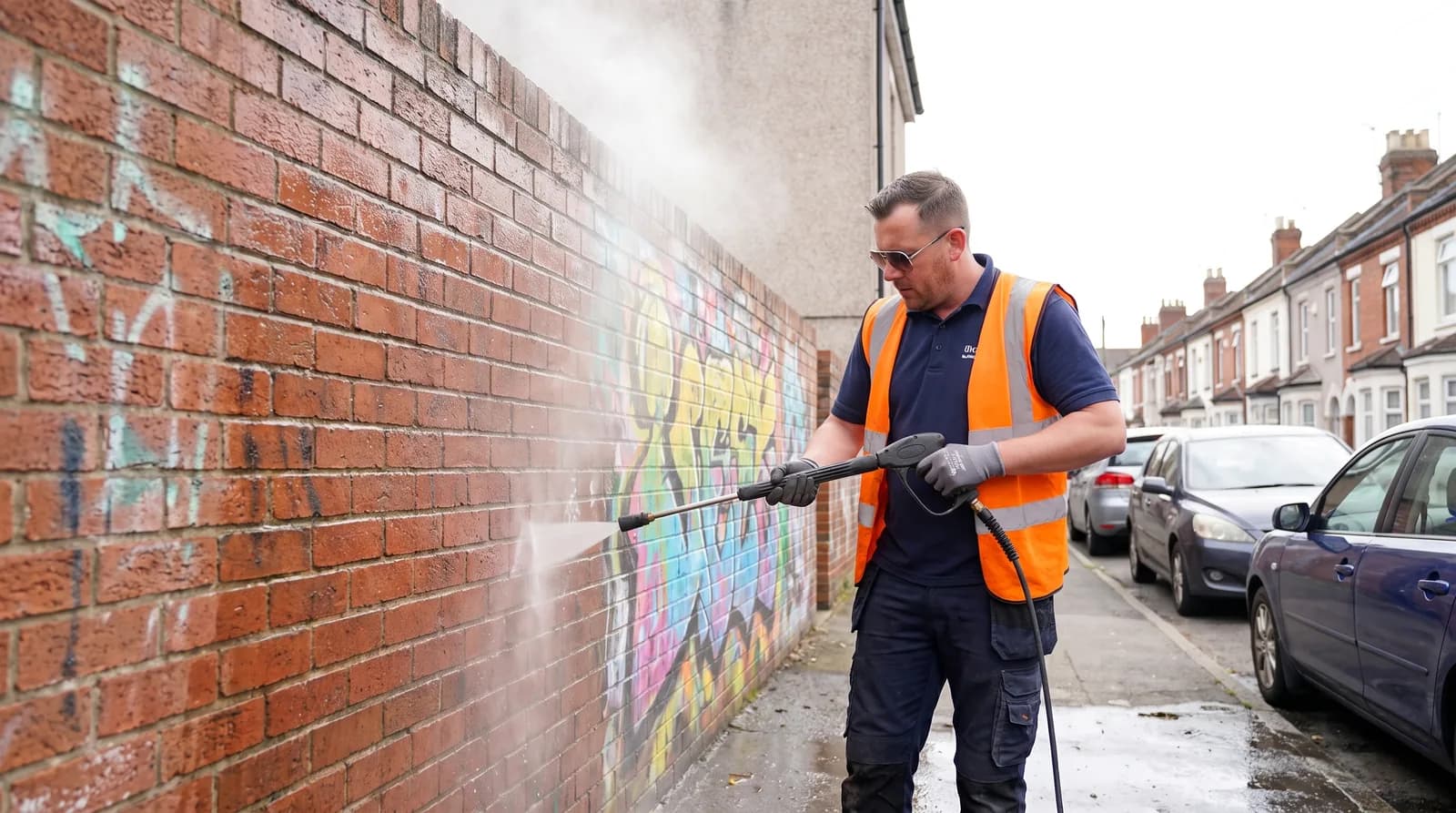
That is why professional removal is led by the surface, not the machine. On painted render or a metal shutter the paint sits on top, and a suitable graffiti remover lifts it cleanly with very little pressure. On bare, porous brick or stone the paint has wicked down into the surface, so the work is about drawing the colour back out with the right poultice or solvent and gentle heat, then rinsing — not battering it off. Getting that judgement right is most of what you are paying for, and it is exactly where a rushed DIY blast goes wrong on a Chester sandstone wall.
The paint or marker matters too. Spray aerosols, permanent markers, emulsion thrown from a tin and etching fluid all bond differently, and each needs a matched remover. A quick test patch in a discreet corner tells us how a particular surface and paint will behave before we commit to the whole area, so there are no nasty surprises halfway through.
Typical UK graffiti removal costs by surface (guide)
| Job | Guide price | What affects it |
|---|---|---|
| Painted or smooth rendered wallPaint sits on top; usually lifts cleanly with the right remover and light cleaning | £90–£200 | Paint sits on top; usually lifts cleanly with the right remover and light cleaning |
| Metal shutter, door or signageNon-porous and often the easiest to clean; larger runs and repainting cost more | £100–£250 | Non-porous and often the easiest to clean; larger runs and repainting cost more |
| Glass or uPVCWipes off well; etched or scratched tags are the exception and cost more | £80–£180 | Wipes off well; etched or scratched tags are the exception and cost more |
| Brick (older / porous)Paint soaks into the pores; needs a poultice or solvent and sometimes a second pass | £150–£350 | Paint soaks into the pores; needs a poultice or solvent and sometimes a second pass |
| Sandstone or natural stoneSoftest, most absorbent and often historic — gentle specialist treatment only | £200–£450 | Softest, most absorbent and often historic — gentle specialist treatment only |
| Anti-graffiti coating (applied to clean surface)Sacrificial or permanent coating so future tags wipe or wash straight off | £10–£40/m² | Sacrificial or permanent coating so future tags wipe or wash straight off |
Typical UK guide ranges for professional graffiti removal, not a CPAGM quote. Non-porous surfaces such as metal, glass and smooth render are usually cheapest; bare brick and soft stone cost most because the paint has to be drawn out rather than wiped off. Whether an anti-graffiti coating is applied is the other big cost driver. Send a few photos for a firm CPAGM price.
What professional graffiti removal involves
- 1
Identify the surface and the paint
We check what the wall is — render, brick, sandstone, painted, metal shutter, glass — and what was used, because the method has to suit both. A test patch in a discreet spot tells us how the surface will react before we treat the whole area.
- 2
Choose the gentlest method that works
Wherever possible we start with the least aggressive approach — a suitable solvent or graffiti remover and controlled cleaning — and only step up to hot-water or low-pressure methods if the surface needs it, to avoid scarring the wall.
- 3
Treat, lift and rinse
The remover is worked into the paint, given time to break the bond, then lifted and rinsed away cleanly. Porous surfaces may need a second pass to draw the last of the colour out of the pores.
- 4
Check the finish and advise on protection
We check there is no ghosting or shadow left behind, leave the area tidy, and let you know if an anti-graffiti coating would make any future tags far quicker and cheaper to remove.
Don't reach for a wire brush or strong chemicals on old stone
Scrubbing graffiti off soft sandstone, historic brick or delicate render with a wire brush or harsh DIY chemicals can permanently scar the surface — and on a listed or conservation-area wall in Chester that can leave a worse mark than the paint did. Strong solvents are also a skin and breathing hazard. If the surface is old, porous, painted or you are unsure, stop and get it looked at before you treat it.
DIY graffiti removal vs professional removal
| DIY attempt | Professional removal | |
|---|---|---|
| Surface safety | Easy to scar brick, lighten paintwork or etch stone | Method matched to the surface, tested first to avoid damage |
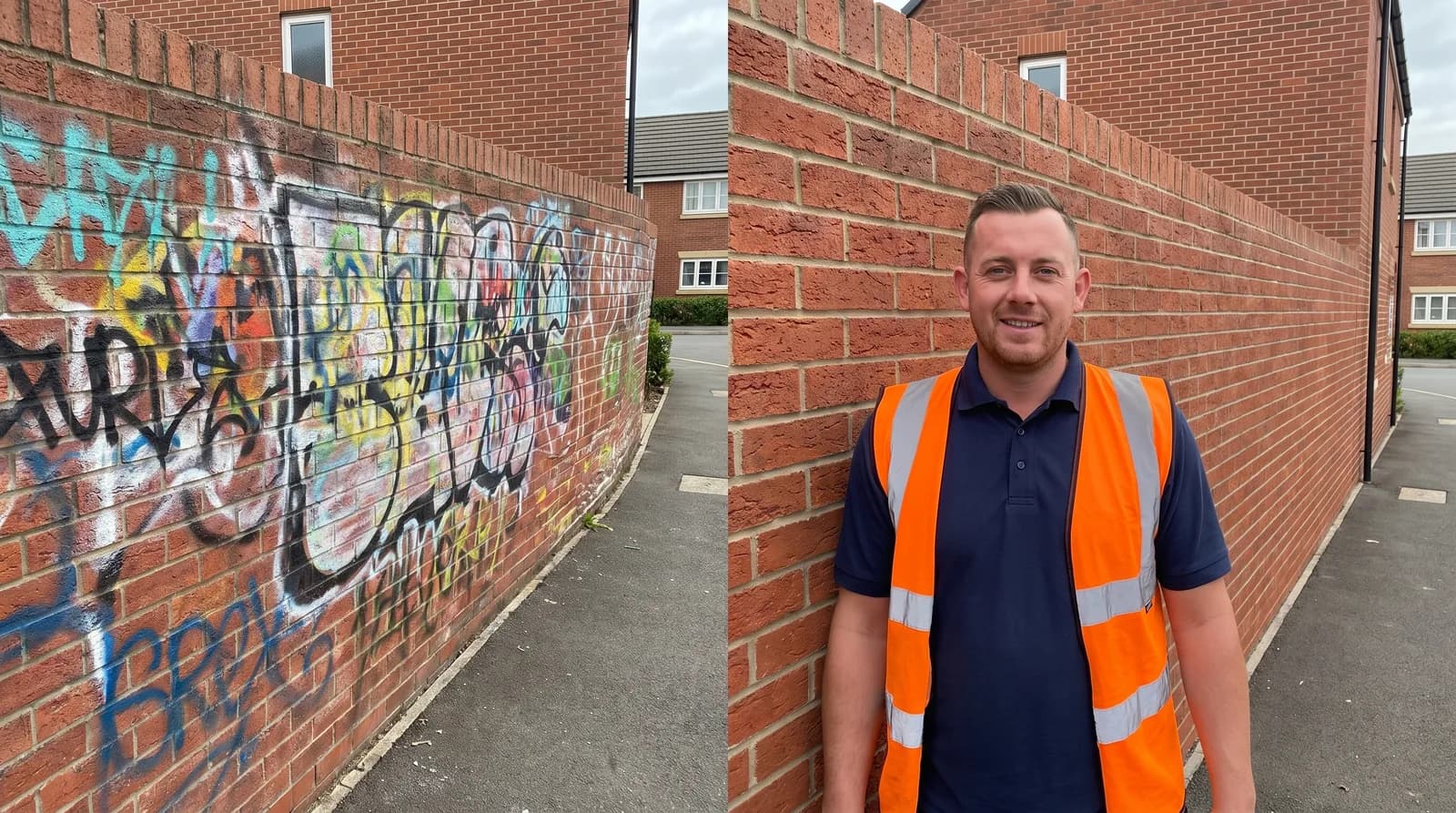
| Result | Often leaves a faded ghost or shadow of the tag | Aims to lift the colour fully, including out of porous surfaces |
| Right product | Hardware-shop removers are hit and miss on baked-on paint | Trade removers and the right technique for the paint used |
| Safety | Strong solvents and working at height bring real risk | Insured, with the right PPE and ground-based methods |
| Typical cost | £15–£40 of product, plus your time and the risk of damage | From £125, insured, with a checked finish |
Commercial premises and rapid response
For a shop, pub, office or managed block, graffiti is more than a cleaning job — it is a frontage that customers see, and a tag left up tends to attract more. Removing it quickly protects the look of the premises and, because fresh paint lifts more easily, keeps the bill down. We cover commercial frontages, shutters, signage, bin stores and boundary walls across Chester, Ellesmere Port, Northwich, Frodsham and the wider area, and can prioritise a fast turnaround where a business needs the frontage clear for opening.
Premises that get hit repeatedly — near stations, car parks, alleyways and licensed venues — are usually better on a standing arrangement than paying for separate one-off visits. We can agree a simple rapid-response plan so a new tag is dealt with within a set time, and pair it with an anti-graffiti coating on the walls or shutters that keep being targeted, so each future clean is quicker and cheaper. Facilities managers and landlords often find one booked response covers several units at once, which is the most cost-effective way to buy the cover.
Are anti-graffiti coatings worth the cost?
An anti-graffiti coating is a clear treatment applied after the wall is clean. Sacrificial coatings form a wax-like barrier that comes away with the paint when the surface is washed, then is reapplied; permanent coatings bond to the surface and let you wipe or gently wash tags off many times without reapplying. As a typical UK guide, coatings run from about £10 to £40 per square metre depending on the type and surface — CPAGM can apply a protective coating as an add-on to a clean, priced with your quote.
The maths is simple. If a wall or shutter is tagged two or three times a year, a coating usually pays for itself quickly, because each future removal drops from a full clean to a quick wipe-down. If a surface has only ever been hit once, it is often not worth it. We will give you an honest view based on how exposed the surface is, rather than coating everything as a matter of course.
Act fast — and report it where it isn't yours
Graffiti on public or council-owned surfaces can usually be reported to your local council, and offensive, racist or threatening graffiti should be reported to the police first. On your own property the quickest wins are simple: photograph it, get it removed while the paint is still fresh, and coat any surface that keeps being targeted. Fresh removal on a protected surface can be a fraction of the cost of leaving weathered paint to soak in.
Photos that get you an accurate graffiti removal price fast
- A clear photo of the graffiti and a wider shot showing the whole surface it is on
- What the surface is — smooth render, painted wall, bare brick, sandstone, metal shutter, glass or uPVC
- Roughly how long the graffiti has been there, and whether it is at ground level or needs height access
- Whether it is a home, boundary wall or commercial frontage, and if the surface has been tagged before
Frequently asked questions
How much does graffiti removal cost?
Graffiti removal in the Chester area starts from £125 for a small tag on an accessible surface. The final price depends on the surface, the size of the area, the type of paint used and how long it has been left on — send a few photos for a firm quote.
What are typical graffiti removal prices in the UK?
As a typical UK guide, a small tag on a smooth, non-porous surface such as metal, glass or painted render is often £80 to £200, while soaked-in paint on bare brick or soft stone can run £150 to £450 because the colour has to be drawn out rather than wiped off. Non-porous surfaces are the cheapest to clean; porous brick and sandstone cost the most.
How much does commercial graffiti removal cost?
Graffiti removal in the Chester area starts from £125, and the price for a shopfront, shutter or larger run is set by the surface, the size of the area and access, confirmed from a few photos. Premises that are targeted repeatedly are usually cheaper on a rapid-response arrangement with an anti-graffiti coating than paying for separate one-off visits.
How much does an anti-graffiti coating cost?
A typical UK anti-graffiti coating costs from about £10 to £40 per square metre depending on the type of coating and the surface; CPAGM can apply a protective coating as an add-on to a clean, priced with your quote. It makes future tags wipe off far more quickly, so it usually pays for itself on any wall or shutter that keeps getting targeted.
How quickly should I get graffiti removed in Chester?
As soon as you reasonably can. Fresh paint lifts more easily and more cheaply than paint that has weathered for weeks or months, and prompt removal also discourages repeat tagging. We aim to respond quickly for both homes and commercial premises across Chester and the surrounding area.
Why can't you just pressure-wash or sandblast it off?
You can on some surfaces, but not all. High-pressure jetting and sandblasting can permanently damage soft sandstone, old brick and render — opening up the surface so it looks worse and soaks up dirt and future paint faster. We match the method to the surface and test a discreet patch first, using pressure only where the surface can safely take it.
Can you remove graffiti from brick and sandstone without damaging it?
Usually yes, but it needs care. Porous surfaces like bare brick and Chester's soft sandstone soak paint in, so we test a discreet patch first and use the gentlest method that works, rather than blasting the surface and risking marking it.
Will it leave a shadow or mark behind?
Sometimes a faint shadow can remain on very porous surfaces, especially if the paint has been there a long time. We work to lift the colour fully and will tell you honestly upfront if a particular surface may not come back to perfect, so there are no surprises.
Do you cover commercial premises and shutters?
Yes. We remove graffiti from shopfronts, boundary walls, shutters and commercial frontages across Chester, Cheshire, Wirral and Wrexham, and can arrange a regular rapid-response for premises that get repeatedly targeted.
Is an anti-graffiti coating worth it?
If a wall or shutter keeps getting tagged, yes. A protective coating means the next lot of paint sits on the surface instead of soaking in, so it wipes off far more quickly and cheaply — which usually pays for itself after one or two repeat incidents. For a surface hit only once, it is often not worth it, and we will say so.