Short answer
To clean a patio: clear the furniture off, sweep it down, then treat the weeds, moss and algae so they die at the root. Now either scrub it with a patio cleaner solution and a stiff brush — no pressure washer needed — or wash at a low-to-moderate pressure suited to your paving. Rinse, let it dry, and brush kiln-dried sand back into the joints. A professional clean starts from £125 if you would rather not tackle it yourself.
Why patios green over so fast in Chester
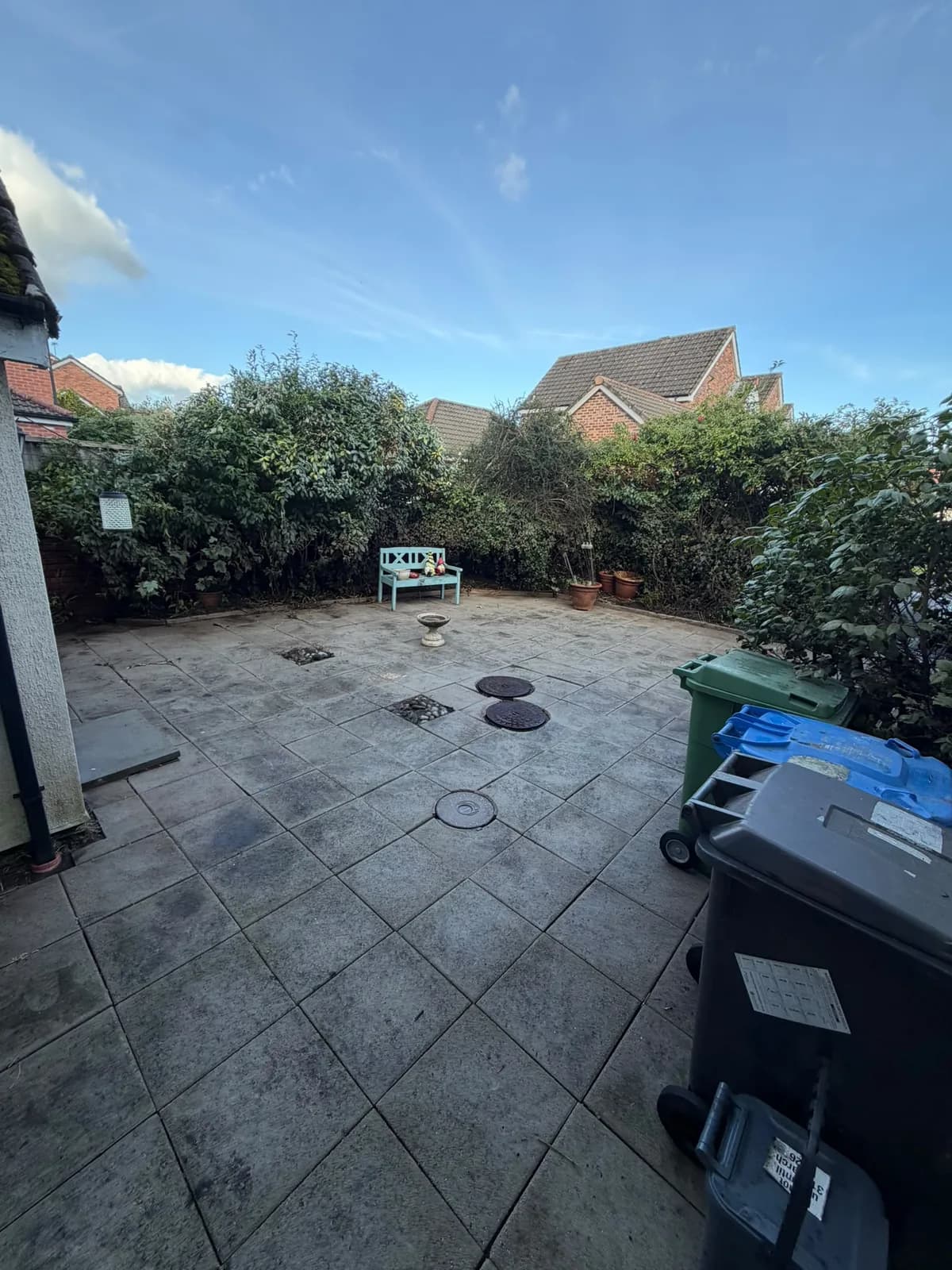
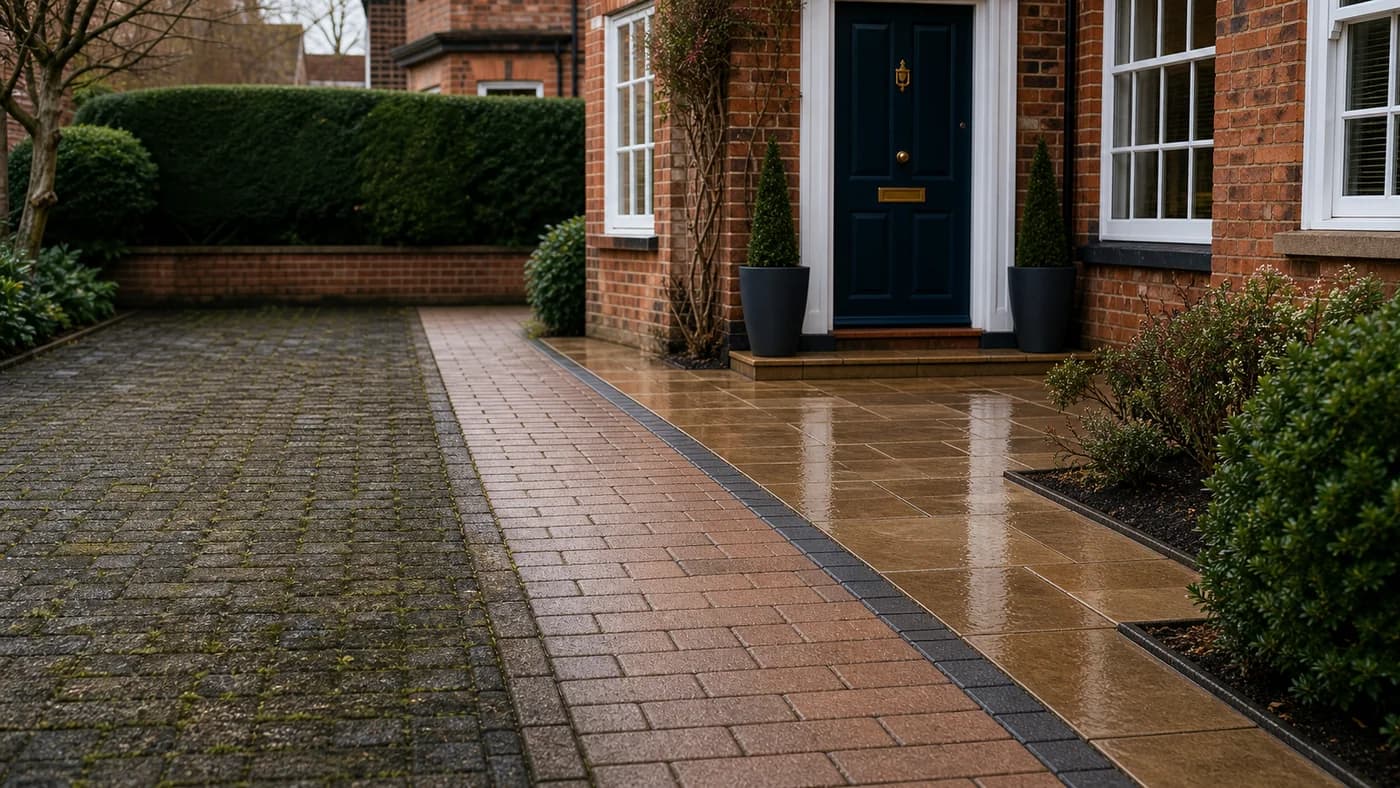
Patios in Chester, Cheshire and the Wirral take a beating from our weather. The ground sits damp for most of the year, north-facing patios behind a house barely catch the sun, and anything under trees or near the Dee greens over within a season. That slippery green film and the black spotting on the slabs are living growth — not just dirt — which is why a quick blast in spring is back looking tired by autumn.
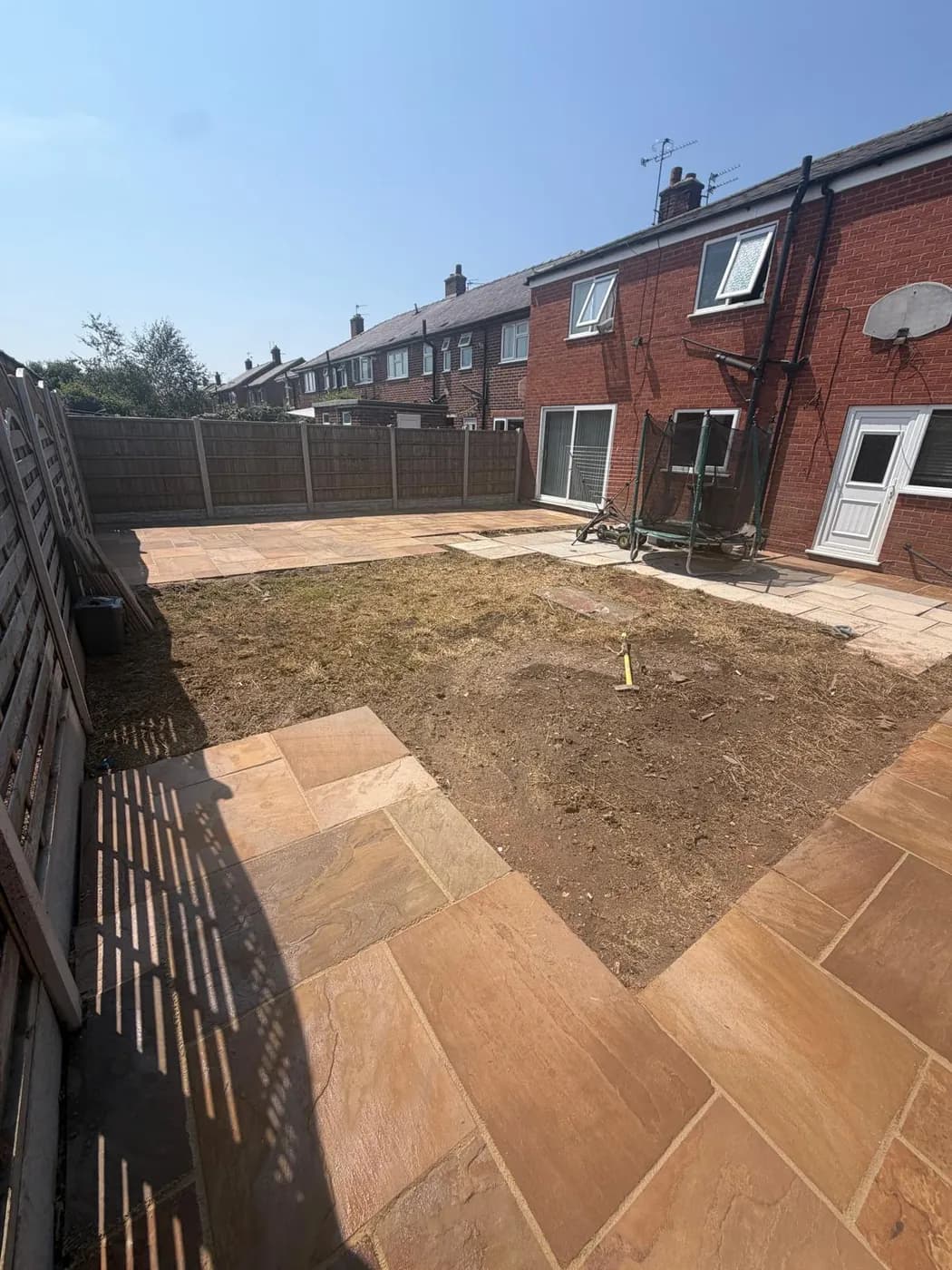
The other thing that catches people out is the paving itself. A lot of Chester homes have older concrete flags or block paving that copes with pressure, but plenty of newer extensions and landscaped gardens around Hoole, Handbridge, Upton and out toward Tarporley and the Wirral have Indian sandstone or porcelain. Those softer, more porous surfaces mark and pit easily, and the wrong technique can ruin them in seconds.
Get the method right and a patio comes up beautifully and stays clean for far longer. Get it wrong and you can strip the surface off the stone, blow the jointing out, and be left with a patchy, striped mess that costs more to put right than a proper clean would have.
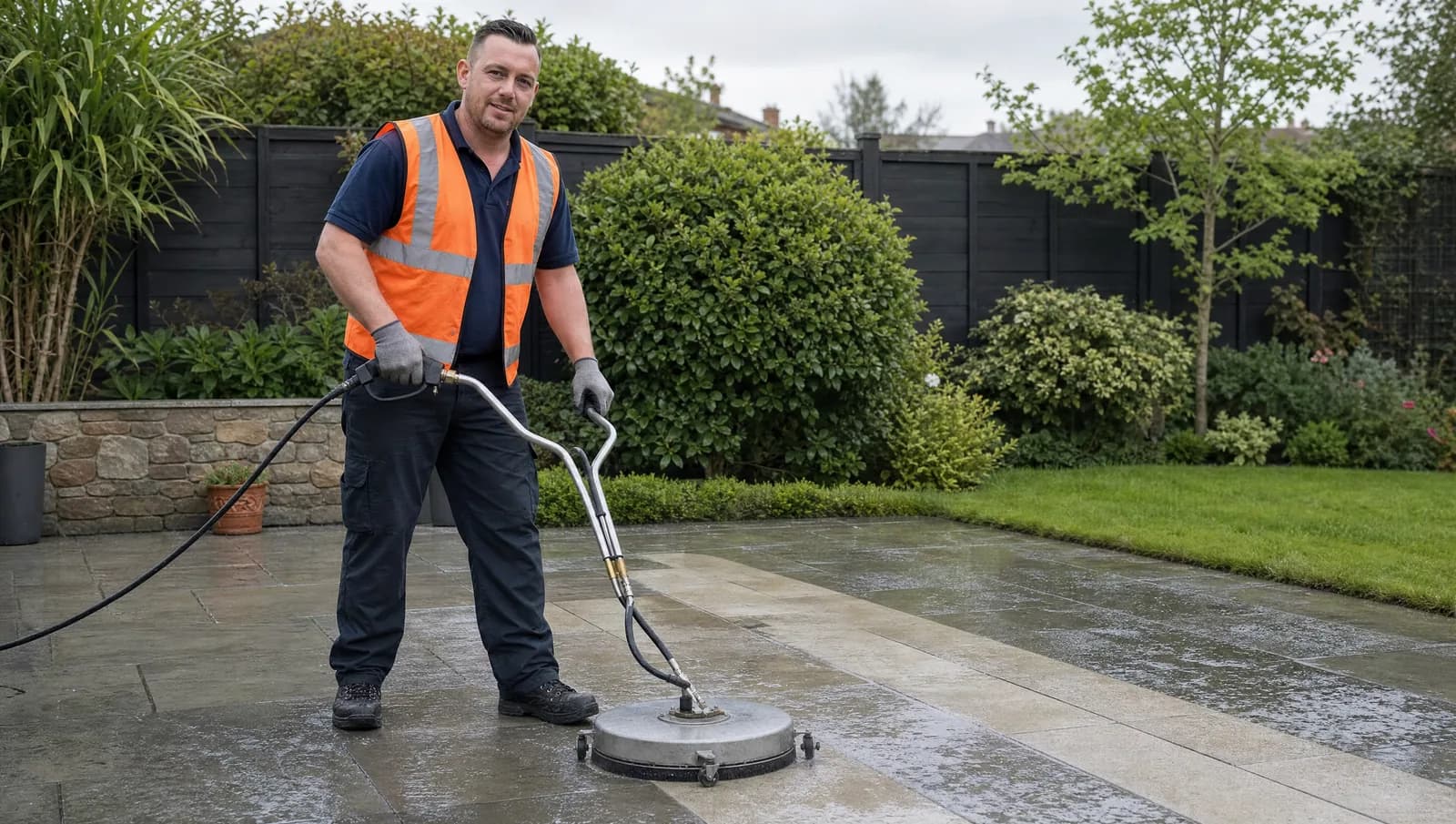
How to clean a patio, step by step
- 1
Clear the patio and sweep it down
Move the furniture and pots off, pull any obvious weeds out of the joints by hand, and give the whole patio a firm stiff-brush sweep to lift the loose moss, leaves and grit. Getting the surface debris off first means you are cleaning the stone itself, not pushing wet slurry around.
- 2
Treat the weeds, moss and algae — and let it work
Apply a patio-safe weed, moss and algae treatment and give it the full time it says on the tub — usually a day or two. This kills the growth at the root so it lifts properly, instead of you scrubbing the green off the top and watching it come straight back within weeks. Keep any treatment off lawns and planted borders.
- 3
No pressure washer? Scrub with a patio cleaner and a stiff brush
You do not need a pressure washer at all. Mix a dedicated patio cleaner (or a mild solution of warm water and washing-up liquid for light dirt), work it in section by section with a stiff outdoor brush, and rinse it away with a hose. It is more elbow grease, but it is far gentler on soft stone and jointing — the safest option on Indian sandstone, limestone and older pointing.
- 4
Using a pressure washer? Match the pressure to your paving
If you do reach for a washer, start on a low setting, keep the lance moving and hold it an even distance from the slabs, working in overlapping passes so you do not leave stripes. Concrete and block paving take more pressure than soft stone. On Indian sandstone or porcelain, ease right off and never hold the nozzle close — those surfaces pit and scar fast. A rotary patio-cleaner attachment gives a far more even finish than a bare lance.
- 5
Tackle black spot separately
Ordinary cleaning will not shift black spot — those stubborn dark, ink-like marks that grip the stone. Spot-treat them with a dedicated black-spot remover, leave it to break the growth down, then rinse. It takes the right product and patience rather than brute pressure, and badly spotted slabs often need more than one application.
- 6
Rinse, dry and re-sand the joints
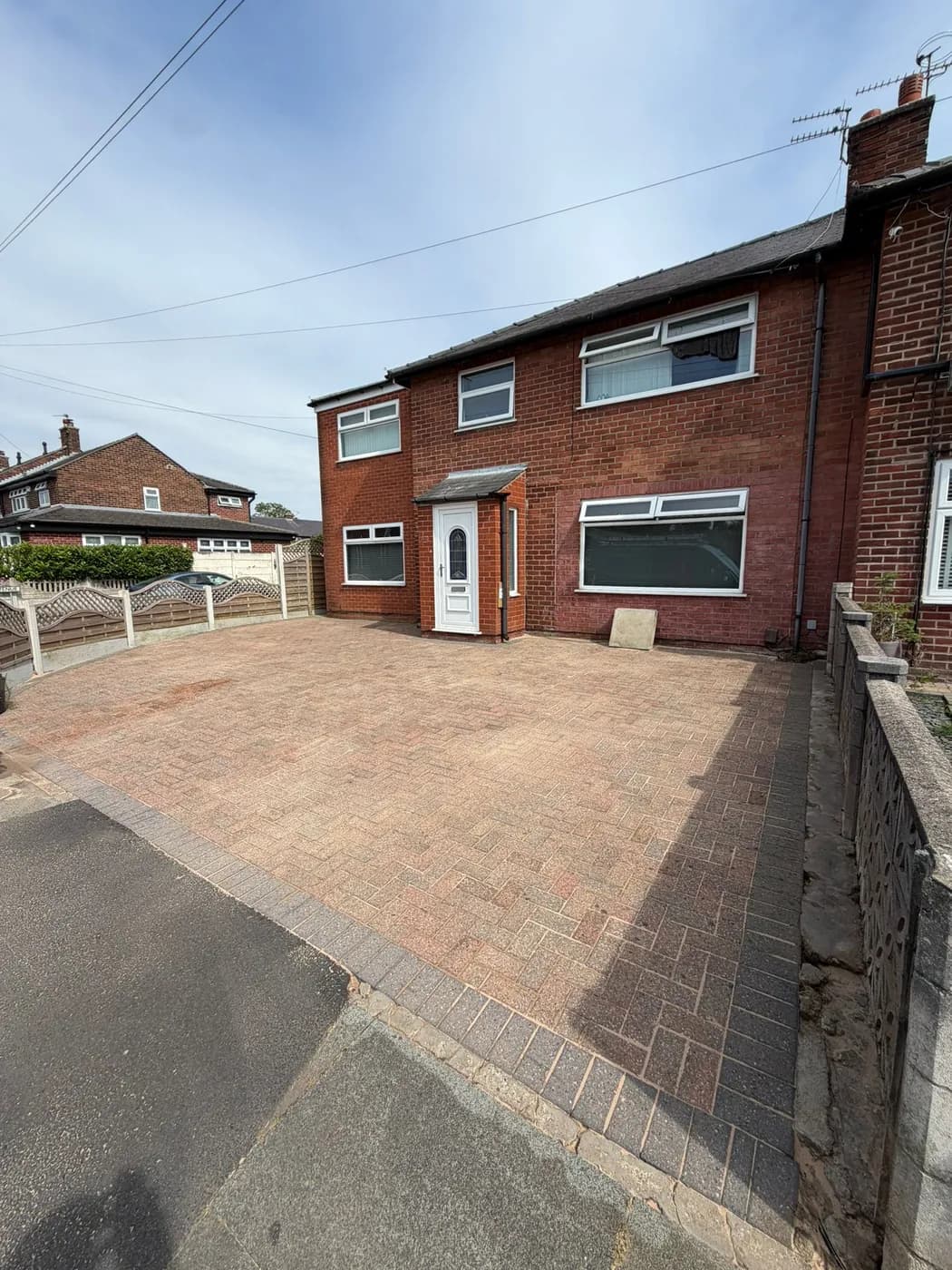
Rinse the residue away toward a drain, not into your borders, then let the patio dry out fully. On block paving and jointed slabs, brush dry kiln-dried sand back into the gaps once the stone is bone dry — that locks everything together and slows the weeds and moss coming back.
How to clean a patio without a pressure washer
You can clean a patio perfectly well without a pressure washer, and on softer stone it is often the better choice. The method is simple: sweep the patio clear, treat the weeds and moss, then scrub the slabs with a patio cleaner solution and a stiff-bristled brush before rinsing it all away with a hose or watering can. It takes more effort than a lance, but you have full control and none of the risk of blasting the surface off the stone or blowing the sand out of the joints.
For light dirt, warm water with a little washing-up liquid or soda crystals lifts grime well. For green algae and ingrained dirt, a purpose-made patio cleaner does the heavy lifting so the brush has less to do. Work in small sections, keep the surface wet while you scrub, and rinse each area before the solution dries. On a large driveway this is genuinely hard graft — which is where a professional clean, from £125, saves you a weekend — but for a small patio or path it gives a really good result with kit you may already own.
How to remove algae and black spot from patio slabs
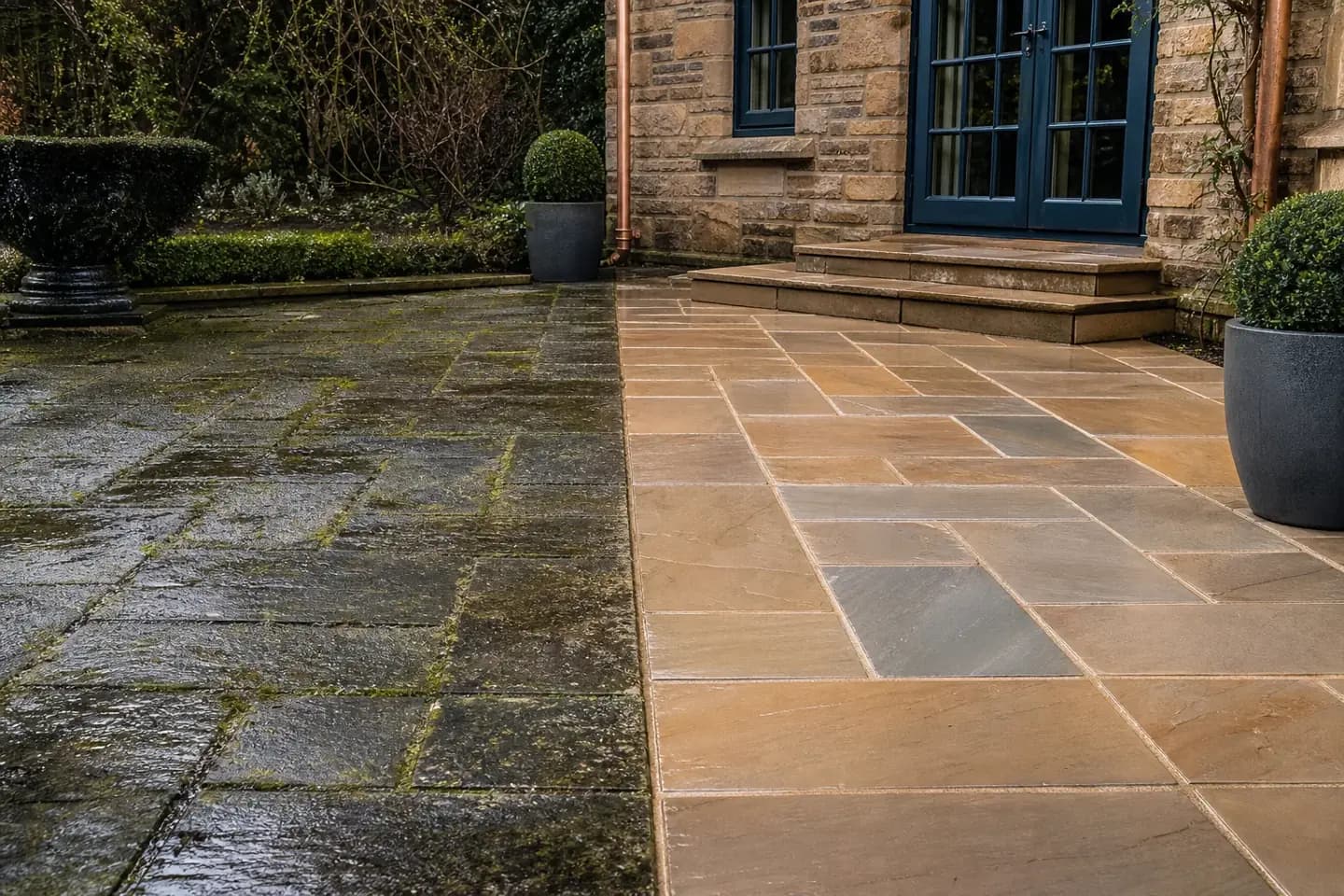
To remove algae from a patio, treat it rather than just wash it. That green film is living growth, so blasting or brushing the top off leaves the roots behind and it greens over again within weeks. Apply a patio-safe algae and moss killer, leave it the time stated on the tub so it dies back at the root, then sweep or gently wash the dead growth away. Repeat once or twice a year on shaded, damp patios and it never gets a proper hold.
Black spot is a different, tougher problem. Those small, dark, ink-like blotches are a lichen that bonds hard to the stone, and they will not shift with a normal wash, a pressure washer, or standard patio cleaner. They need a dedicated black-spot remover left to break the growth down, sometimes over more than one application. It is removable, but it is as much a specialist treatment as a clean — on a badly spotted patio it is often quicker and cheaper to have it done properly than to keep buying products that do not quite work.
Professional patio & driveway cleaning — CPAGM guide prices
| Job | Guide price | What affects it |
|---|---|---|
| Small patio or path cleanCompact area, single surface, easy access — moss and algae removed | From £125 | Compact area, single surface, easy access — moss and algae removed |
| Standard driveway cleanLarger block-paved or flagged driveway, cleaned evenly across the whole area | Confirmed from photos | Larger block-paved or flagged driveway, cleaned evenly across the whole area |
| Re-sanding the joints (add-on)Fresh kiln-dried sand brushed back into block paving or jointed slabs after cleaning | Priced with your quote | Fresh kiln-dried sand brushed back into block paving or jointed slabs after cleaning |
Patio and driveway cleaning starts from £125 for typical Chester properties. Every job is confirmed after you send a few photos or the details, because the surface type, area, level of growth and whether you want the joints re-sanded all change the scope. We cover Chester and roughly a 45-minute radius — Hoole, Handbridge, Upton, Saughall, Frodsham, Northwich, Ellesmere Port and out toward Tarporley.
What DIY patio cleaning kit typically costs
| Job | Guide price | What affects it |
|---|---|---|
| Pressure washer hire (weekend)Domestic machine; a rotary patio-cleaner attachment is often extra | £40–£60 | Domestic machine; a rotary patio-cleaner attachment is often extra |
| Patio cleaner / algae & moss treatmentConcentrate that covers a typical patio; more for larger areas | £10–£25 | Concentrate that covers a typical patio; more for larger areas |
| Black-spot removerSpecialist product; badly spotted patios need more than one bottle | £15–£30 | Specialist product; badly spotted patios need more than one bottle |
| Kiln-dried jointing sandFor re-sanding block paving and jointed slabs once bone dry | £8–£15 per bag | For re-sanding block paving and jointed slabs once bone dry |
| Stiff outdoor brushThe one tool the no-pressure-washer method really needs | £8–£20 | The one tool the no-pressure-washer method really needs |
Typical UK guide prices, not CPAGM charges — shown so you can weigh a DIY clean against a professional one. On a small patio the DIY route is realistic; on a big driveway the hire, products and a lost weekend often add up to more than a professional clean would cost.
When to put the pressure washer down
A pressure washer held too close, or on too high a setting, will strip the surface off Indian sandstone, blow the jointing sand out, force water under the slabs and lift loose paving. If your pointing is already crumbling, the slabs rock underfoot, or you are not sure how your stone will react, stop. On delicate or failing paving the damage is real and expensive to fix — far more than the clean would have cost. Get it looked at first.
DIY patio clean vs a professional clean
| DIY with a hired washer | Professional clean | |
|---|---|---|
| Finish | Easy to leave stripes, swirls and patchy slabs | Even, consistent finish across the whole patio |
| Surface safety | Real risk of scarring soft stone or blowing out joints | Right pressure and technique matched to your paving |
| Regrowth | Moss and weeds often return within weeks | Pre-treated growth and re-sanded joints slow it right down |
| Effort and mess | Hours of hard work, soaked and covered in slurry | Done in one visit, area cleared and left tidy |
| Typical cost | From £40 hire, plus products and your whole day | From £125, insured, with a finished result |
The best way to clean a patio (and keep it clean)
The best way to clean a patio is the patient way, not the powerful way: treat the growth first, clean gently with a patio solution and a brush (or low pressure), and re-sand the joints afterwards. Rushing straight in with a pressure washer on full power is what wrecks patios — it strips soft stone, blows out the pointing and leaves stripes you cannot undo. Let the treatment kill the moss and algae at the root, and the actual cleaning becomes far easier and much kinder to the paving.
Keeping it clean is mostly about staying ahead of the weather. In Chester's damp climate, a quick moss and algae treatment once or twice a year, a regular sweep so leaves do not rot into the surface, and topped-up jointing sand will keep a patio looking clean for years between deeper cleans. North-facing and tree-shaded patios — common right across Cheshire and the Wirral — green over fastest and reward a little more attention.
What you need to clean a patio yourself
- A stiff outdoor broom or brush, plus a hose or watering can for rinsing
- A patio-safe weed, moss and algae treatment — and a black-spot remover if you have dark lichen marks
- A patio cleaner solution (or warm water and washing-up liquid for light dirt)
- Dry kiln-dried sand for re-sanding block paving or jointed slabs afterwards
- A dry, settled day or two — treatments and re-sanding both need the patio to dry out
Photos that get you an accurate price fast
- A wide photo of the whole patio so the area and layout are clear
- A close-up of the worst patches — black spots, thick green algae, or weeds in the joints
- A photo showing the surface type (sandstone, porcelain, concrete, block paving) and how the patio is accessed
Frequently asked questions
What is the best way to clean a patio?
The best way to clean a patio is to treat the moss and algae first, then clean gently — with a patio cleaner and a stiff brush, or a pressure washer on a low setting matched to your paving — and re-sand the joints afterwards. Treating the growth at the root before you clean means it lifts properly and stays away far longer than a quick blast.
How do you clean a patio without a pressure washer?
Sweep the patio clear, treat the weeds and moss, then scrub the slabs with a patio cleaner solution (or warm water and washing-up liquid for light dirt) using a stiff outdoor brush, and rinse with a hose. It takes more effort than a pressure washer, but you keep full control and it is much safer on soft stone and old pointing.
How do I remove algae from a patio?
Algae is living growth, so treat it rather than just wash it. Apply a patio-safe algae and moss killer, leave it the time stated on the tub so it dies at the root, then sweep or gently rinse the dead growth away. Blasting the green off the top alone leaves the roots behind and it returns within weeks.
Can I jet wash an Indian sandstone patio?
Only with great care. Sandstone is soft and porous, so a high-pressure jet held close will pit and scar it. Use a low setting, keep the nozzle well back and moving, or clean it with a brush and patio solution instead. If in doubt, get it looked at first — the damage is permanent.
Does a pressure washer damage patios?
It can. A pressure washer used too close or on too high a setting strips the surface off soft stone like Indian sandstone, blows the jointing sand out, and can force water under the slabs. On concrete and block paving it is safer, but always start low, keep the lance moving, and never hold the nozzle close on delicate paving.
What household products can I use to clean a patio?
For light dirt, warm water with a little washing-up liquid or soda crystals and a stiff brush works well. Avoid neat bleach and salt — they can discolour stone and harm nearby plants and lawns. For green algae and black spot you need proper patio treatments, because household products do not kill the growth at the root.
What is the black spotting on my slabs and can it be removed?
Black spot is a stubborn lichen that grips the stone and will not shift with a normal wash or a pressure washer. It needs a dedicated black-spot treatment to break it down. It can be removed, but it takes the right product and patience — sometimes more than one application — rather than brute pressure.
How often should I clean my patio in Chester?
Most patios benefit from a clean every one to two years. Shaded, north-facing or tree-lined patios in our damp Cheshire climate green over faster and often need doing yearly, with a moss and algae treatment once or twice a year in between to stay on top of it.
Will the moss and weeds just come straight back?
Not if it is done properly. Pre-treating the growth so it dies at the root, rather than just blasting the surface, and re-sanding the joints afterwards makes it much harder for moss and weeds to take hold again.
Do I need to re-sand the joints after cleaning?
On block paving and jointed slabs, usually yes. Cleaning lifts the old sand out of the gaps, and that sand is what locks everything together and helps keep weeds down. Brush dry kiln-dried sand back in once the patio is fully dry, or add it as a finish to a professional clean, priced with your quote.
How much does professional patio cleaning cost?
As a guide, patio and driveway cleaning starts from £125 for a small patio or path, and re-sanding the joints can be added and priced with your quote. Every job is confirmed after you send a few photos or the details, because the surface, area, level of growth and re-sanding all change the scope. We cover Chester and roughly a 45-minute radius.
Sources & further reading